
Ctrl K
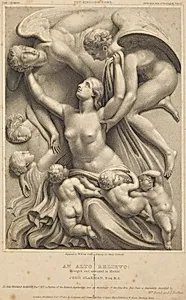
The print known as *Thy Kingdom Come* (1810) represents a characteristic collaboration of British Neoclassical artists: the original marble monument designed and executed by the sculptor John Flaxman, an intermediary drawing by Henry Corbould, and the finished stipple engraving by William Bond. Published in John Britton’s *The Fine Arts of the English School* (1812), the plate reproduces a figure of a veiled woman in prayer from Flaxman’s monument (commissioned for Micheldever Church, Hampshire). Flaxman, born in York in 1755, entered the Royal Academy Schools in 1770, later designed for Josiah Wedgwood, spent formative years in Rome (1787–1794), and became the Academy’s first professor of sculpture in 1810. His spare linear style, inspired by antique reliefs and Greek vase painting, made him one of Europe’s most influential Neoclassicists.
Henry Corbould, born in London in 1787, studied painting with his father Richard Corbould and at the Royal Academy under Henry Fuseli, where he formed a friendship with Flaxman. He devoted much of his career to precise drawings after sculptures—both ancient marbles and contemporary works—for publication, supplying the intermediary design that Bond translated into print. William Bond, active from 1772, studied stipple engraving under the Italian master Francesco Bartolozzi. Ranked among the leading practitioners of the technique alongside Richard Earlom and John Ogborne, Bond was nominated first president of the Society of Engravers in 1803. His dotted manner was ideally suited to capturing the soft modeling and contemplative mood of Flaxman’s marble.
The resulting engraving, issued by Longman & Co., Josiah Taylor, and Bond himself, belongs to the English School’s effort to document and disseminate native sculpture through high-quality reproductive prints. Bond’s stipple work preserves the monument’s quiet piety and classical drapery while making Flaxman’s design available to a wider audience of collectors and students. Together the three artists exemplify the tightly linked worlds of sculpture, drawing, and engraving that defined British Neoclassicism around 1800. Their joint production helped carry Flaxman’s linear, antique-inspired aesthetic into illustrated books and private collections, ensuring its lasting visibility long after the original marble was installed.
All 1 artworks loaded