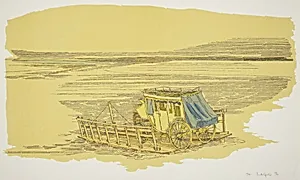
William Richard Crutchfield (January 21, 1932 – April 20, 2015) was an American painter, printmaker, and sculptor born in Indianapolis, Indiana, who became celebrated for monumental color lithographs of industrial machinery, trains, and aircraft. He received his Bachelor of Fine Arts from the Herron School of Art at Indiana University in 1956, followed by a Master of Fine Arts from Tulane University in New Orleans in 1960. A Fulbright scholarship then took him to the Hochschule für bildende Künste in Hamburg, Germany, where he absorbed the rigorous draftsmanship traditions of European print culture.
Returning to the United States, Crutchfield taught foundation studies and advanced drawing at the Herron School of Art from 1962 to 1965 before serving as chairman of Foundation Studies at the Minneapolis College of Art from 1965 to 1967. He relocated to California in 1967, settling in the port community of San Pedro, where the industrial harbor landscape — its ships, cranes, and rail yards — became the enduring subject of his art. Working at Gemini G.E.L. in Los Angeles, he developed a signature lithographic technique in which tusche was applied with a pen and multiple colors blended directly on the roller, producing the atmospheric, machine-precise imagery that defined his mature style. He also produced his Five Trains series at the Tyler workshop in New York between 1977 and 1978, large-format lithographs printed from stone and aluminum plates. The 1928 transatlantic voyage of the Graf Zeppelin served as one of his recurring inspirational sources.
Crutchfield was named Distinguished Artist of Los Angeles in 1982 and received the Music Center Club 100 Award. His work entered the permanent collections of the Museum of Modern Art in New York, the Metropolitan Museum of Art, the National Gallery of Art in Washington, D.C., the Art Institute of Chicago, the Brooklyn Museum, the Blanton Museum of Art, the Tate in London, and the National Gallery of Australia, among many other institutions. He stands as a significant figure in the American printmaking renaissance of the 1970s, transforming the industrial sublime into carefully crafted, sensory works on paper.