
Ctrl K
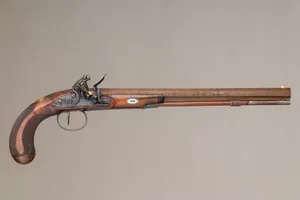
Robert Wogdon (1734–1813) and John Barton (active 1795–1819) were premier British gunsmiths based in London, whose partnership as Wogdon & Barton from 1795 to 1803 elevated the craft of flintlock pistol-making to the level of high art. Wogdon, born in January 1734, began producing flintlock firearms in the 1760s, establishing a reputation for precision engineering and elegant design that made his name synonymous with the deadly elegance of duelling pistols. Little is documented about Wogdon's early training, though his mastery suggests immersion in London's vibrant gunsmithing trade. By the late 18th century, he partnered with Barton, whose skills complemented Wogdon's, allowing the firm to dominate the market for bespoke arms among the aristocracy and military elite.
Working in the neoclassical tradition of English gunmaking, Wogdon & Barton's pistols exemplified refined functionality fused with aesthetic sophistication. Their weapons featured smoothbore barrels, often inscribed with the makers' names in gold, and innovative set triggers—hair triggers that required minimal pressure for discharge, enhancing accuracy in high-stakes encounters. These were not mere tools but sculpted masterpieces, with polished walnut stocks, engraved lockplates, and blued steel finishes that rivaled the silversmiths of the era. Notable surviving works include a c.1800 flintlock target pistol made for Prince William Frederick, Second Duke of Gloucester and Edinburgh (1776–1834), complete with case and bullet mold stamped "74," now in the Metropolitan Museum of Art. Most famously, Wogdon crafted the pair of pistols used in the 1804 Burr–Hamilton duel in Weehawken, New Jersey, which embodied the firm's lethal precision.
Wogdon retired in 1803, after which Barton continued the legacy until around 1819. Wogdon died on 28 March 1813 at age 79 and was buried alongside his wife Jane (d. 1805) in the chancel of St Bartholomew's Church. Their pistols inspired contemporary verse lamenting their role in duels, as in a poem decrying Wogdon's fame for "leaden death." Today, Wogdon & Barton's arms are celebrated in collections like the National Firearms Museum and Museum Victoria, symbolizing the intersection of artistry, technology, and Regency-era honor culture. Their enduring influence underscores how 18th-century British gunsmithing transformed functional objects into coveted icons of design.
(Word count: 378)
All 1 artworks loaded