
Ctrl K
1300–1370
Yao Tingmei, also known as Yao Yanqing or simply Tingmei (ca. 1300–after 1360), was a Chinese landscape painter active during the late Yuan dynasty (1271–1368), a period marked by Mongol rule, political instability, and the rise of literati art as a form of cultural resistance and introspection. Born in Wuxing (present-day Huzhou), Zhejiang province—a vibrant hub of scholarly activity—he embodied the ideals of the scholar-gentleman, channeling the turmoil of Red Turban rebellions and dynastic decline into serene visions of nature's harmony. Little is known of his early life or formal training, but his oeuvre reveals deep engagement with Northern Song precedents.
Yao worked in the Li-Guo landscape tradition, pioneered by Li Cheng (919–967) and Guo Xi (ca. 1000–ca. 1090), which he adapted through the lens of his fellow Zhejiang natives Zhao Mengfu (1254–1322) and Tang Di (1287–1355). His style featured schematic, calligraphic brushwork—dense textured fissures alternating with stark white voids for snow paths, prominent dots for rocky cavities, misty washes, and layered foliage—evoking antiquity while simplifying descriptive complexity into expressive, atmospheric effects. As part of the Yuan literati movement, Yao's paintings prioritized personal withdrawal, scholarly leisure, and text-image interplay, often incorporating poetry and calligraphy from peers amid Jiangnan's elite networks.
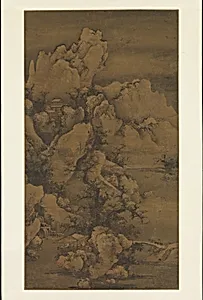
Among his surviving major works, *Traveling through Snow-Covered Mountains* (雪山行旅圖), a hanging scroll in ink on silk (image: 98.4 × 54.6 cm), captures arduous winter treks across rugged peaks, its unsigned surface identified by distinctive mannerisms. Even more celebrated is *Leisure Enough to Spare* (有餘閒, dated 1360), a monumental handscroll in ink on paper (overall: 23.8 × 734 cm) at the Cleveland Museum of Art, unfolding misty mountains, thatched hermitages, and tranquil figures in rustic pursuits, adorned with over 20 poems and bold calligraphy by the poet Yang Weizhen (1296–1370) and others—dedicated to an ascetic named Du. A debated attribution, *Winter Landscape* (mid-1300s), resides at the Museum of Fine Arts, Boston.
Yao's legacy endures in major collections like the Metropolitan Museum of Art and Cleveland Museum, bridging Song imperial grandeur with Ming introspection and exemplifying literati resilience under foreign rule. His sparse but poignant corpus, revived through 20th-century scholarship by figures like James Cahill and Richard Barnhart, underscores the collaborative spirit of Yuan art, where paintings served as social canvases for intellectual bonds.
All 1 artworks loaded