Ctrl K
1198–1283
Zakariya al-Qazwini (full name Abū Yaḥyā Zakariyyāʾ ibn Muḥammad ibn Maḥmūd al-Qazwīnī), born around 1203 in Qazvin, Iran, belonged to a distinguished family of Muslim jurists descended from Anas ibn Malik, a companion of the Prophet Muhammad. In 1220, at about age 16 or 17, he fled the Mongol invasions led by Genghis Khan and settled in Mosul, where he spent two decades studying mathematics, astronomy, philosophy, religion, and geography. There he studied under the philosopher Athir al-Din al-Abhari and interacted with leading scholars including the geographer Yaqut al-Hamawi and the historian Ibn al-Athir; he also visited the Sufi master Ibn Arabi in Syria. This rigorous training in both legal and scientific traditions prepared him for a distinguished career as a jurist and scholar.
After relocating to Wasit near Baghdad, al-Qazwini served as a professor at the legal college al-Madrasa al-Sharabiyya and as chief qadi (judge) under the last Abbasid caliph, al-Musta'sim. Following the Mongol sack of Baghdad in 1258, he continued his roles under Ilkhanid rule and entered the circle of the governor Ata-Malik Juvayni, to whom he dedicated his most famous work. Al-Qazwini’s writings reflect the intellectual ferment of the era, synthesizing Greek, Persian, and Islamic knowledge while responding to the upheavals of Mongol conquest by presenting a divinely ordered cosmos. He died in Wasit in 1283.
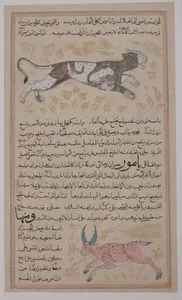
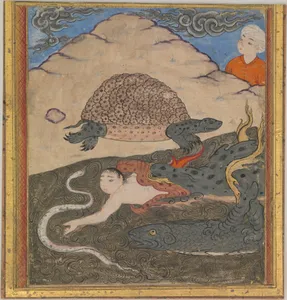
Al-Qazwini’s masterpiece, ʿAjāʾib al-makhlūqāt wa-gharāʾib al-mawjūdāt (Wonders of Creation and Oddities of Existence), composed in the mid-13th century, is a seminal cosmography that describes the heavens, angels, earth, plants, animals, and marvels in a hierarchical structure inspired by Ibn Sina’s philosophy of emanation. Frequently illustrated from the author’s lifetime onward, the text became one of the most popular and widely copied works in the Islamic world, with lavishly painted manuscripts produced in Ilkhanid Iraq, later Persian, Ottoman, and Indian (Deccan) ateliers. His geographical dictionary Āthār al-bilād wa-akhbār al-ʿibād further compiled knowledge of lands and peoples. These illustrated volumes, blending scientific observation with wonder, form the core of his artistic legacy in museum collections.
Al-Qazwini’s cosmography profoundly shaped Islamic visual culture, inspiring generations of miniature painters who depicted celestial spheres, fantastical creatures, and natural wonders in styles ranging from early Mesopotamian traditions to later Safavid and Mughal interpretations. Copied and translated into Persian and Turkish for centuries, his work remains a cornerstone of Islamic art and science, offering viewers a window into 13th-century encyclopedic thought and the enduring power of illustrated knowledge.