Ctrl K
1490–1563
Zhang Lu (ca. 1490–ca. 1563), known by his courtesy name Tianchi and art name Pingshan, was born into a wealthy aristocratic family in Xiangfu (present-day Kaifeng, Henan Province). Educated alongside princes of the imperial family, he attended the Imperial Academy as a government student but, after failing the examinations owing to his unrestrained personality, abandoned official ambitions to pursue painting full-time. He began by emulating the leading court painter Wang E before studying under Wu Wei and aligning himself with the Zhe school tradition founded by Dai Jin.
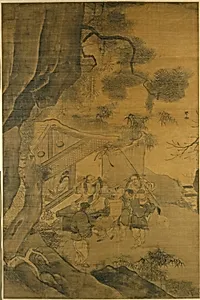
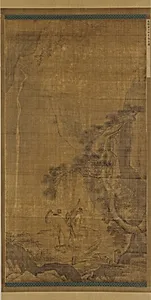
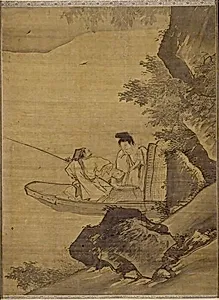
A representative master of the later Zhe school, Zhang Lu specialized in landscapes and figure paintings, especially lively depictions of immortals, scholars, fishermen, and rustic gatherings. His style shifted from early meticulous refinement to a bold, freehand manner marked by swift, uninhibited brushwork, vigorous ink washes, and large axe-cut texture strokes derived from Song masters Ma Yuan and Xia Gui as well as Dai Jin. Figures are rendered with simple, unadorned modeling that conveys strong lifelike presence, while landscapes capture dramatic weather, rushing water, and windswept trees with expressive energy. He also painted birds, animals, and flowers.
Among his major surviving works are *Laozi Riding an Ox*, the hanging scroll *Studying a Painting* (a witty parody of a scholarly gathering in which rustics examine a hawk-and-rabbit composition of Zhang’s own invention), *Flute-Playing Female Immortal*, *Eagle Chasing a Hare*, and *Approaching Storm*. These ink-and-color paintings on silk, now held in collections such as the Metropolitan Museum of Art, the Palace Museum in Beijing, and the Nanjing Museum, exemplify his dynamic yet accessible vision. Despite professional success, Zhang lived simply, almost as a hermit, refusing paid commissions from officials while freely creating for fellow scholars. Together with Li Mengyang’s writings and Zuo Guoji’s calligraphy, his art was hailed as one of the “Three Wonders of Xiangfu.” Later literati sometimes dismissed his vigorous manner as belonging to the “Wild and Heterodox School,” yet he remains a vital figure in Ming painting, bridging court and professional traditions with lasting influence.