
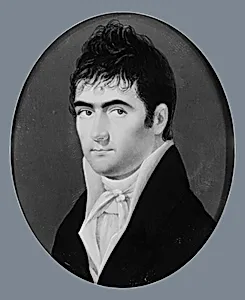
Self-portrait
Thomas Gimbrede, ca. 1805
About this artwork
Thomas Gimbrede's *Self-Portrait* (ca. 1805) is a exquisite example of early American miniature painting, rendered in watercolor on ivory and measuring just 3 x 2 7/16 inches. This diminutive format demanded extraordinary skill—a steady hand and meticulous attention to detail—to achieve the luminous flesh tones and subtle gradations that bring the artist's likeness to life. The translucent ivory support glows beneath the pigments, enhancing the portrait's lifelike quality and showcasing Gimbrede's mastery of a technique prized for its jewel-like precision. Born in France in 1781, Gimbrede immigrated to the United States in 1802, settling in New York and Baltimore as an engraver and miniaturist. He later taught drawing at West Point from 1819 until his death in 1832, famously distilling his philosophy to "only two lines in drawing: the straight line and the curve line." This self-portrait, acquired by The Metropolitan Museum of Art in 1938 through the Fletcher Fund, captures his professional identity amid America's burgeoning portrait tradition. In an era before photography, such miniatures held deep cultural importance as portable tokens of affection for families and loved ones separated by distance. Gimbrede's work not only preserves a personal visage but also celebrates the artist's technical prowess, bridging European finesse with early American artistry.