
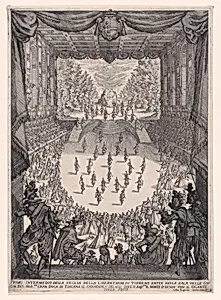
1er Intermède (1st Interlude), from Les Intermèdes (The Interludes)
Medium
Etching; fourth state of four (Lieure)
Dimensions
Sheet: 11 7/16 x 8 1/4 in. (29 x 20.9 cm) Plate: 11 1/4 x 8 1/16 in. (28.6 x 20.5 cm)
Classification
Prints
Department
Drawings and Prints
Museum
Metropolitan Museum of Art, New York, NY
Credit
A. Hyatt Mayor Purchase Fund, Marjorie Phelps Starr Bequest, 1996
Accession Number
1996.66
Rights
Public Domain
Art Historical Context
This etching titled *1er Intermède (1st Interlude)* belongs to the series *Les Intermèdes* (The Interludes), created 1616 through the collaboration of Jacques Callot and Giulio Parigi. As the opening work in the series, it reflects the tradition of interludes—short theatrical entertainments performed between acts of larger spectacles at European courts during the early seventeenth century. The print captures the lively spirit of these events through Callot’s precise line work. Etching was particularly suited to Callot’s practice, allowing him to render intricate architectural settings, figures, and decorative details on the copper plate. This impression represents the fourth and final state, illustrating how printmakers refined compositions through successive alterations. Now in the Metropolitan Museum of Art’s collection of Drawings and Prints, the work exemplifies how such etchings preserved the visual record of courtly pageantry for wider audiences. Measuring roughly 11 by 8 inches, the sheet rewards close viewing, revealing the technical finesse that made Callot one of the most influential printmakers of his era.
About the Artist
Jacques Callot|Giulio Parigi · 1592–1635
Jacques Callot (1592–1635) was a French printmaker and draftsman from the Duchy of Lorraine, widely regarded as one of the first great artists to practice the graphic arts exclusively. His more than 1,400 etchings chronicled the breadth of 17th-century life, from Medici court festivities to the brutal realities of warfare. Callot revolutionized etching through technical innovations including the é...