
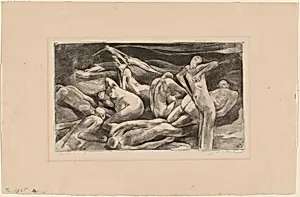
30th Canto, Falsifiers in Deeds
1923
Medium
softground etching and drypoint in black on wove paper
Dimensions
plate: 13.81 × 23.81 cm (5 7/16 × 9 3/8 in.) sheet: 24.13 × 36.51 cm (9 1/2 × 14 3/8 in.)
Classification
Department
CG-W
Museum
National Gallery of Art, Washington, D.C.
Credit
Gift of Christopher and Beverly With in memory of Karl and Gerda With
Accession Number
2019.156.9
Rights
Public Domain
Art Historical Context
Willy Jaeckel's *30th Canto, Falsifiers in Deeds* (1923) draws from Dante Alighieri's *Inferno*, the first part of the *Divine Comedy*. This etching captures the harrowing scene from Canto 30, where sinners punished for falsifying words, deeds, coins, and identities writhe in torment amid disease and madness in Hell's Eighth Circle. Jaeckel, a German printmaker active in the early 20th century, channels the epic's moral allegory into a stark, intimate vision, reflecting the Weimar era's fascination with medieval themes amid post-World War I disillusionment. Rendered in softground etching and drypoint on wove paper, the work showcases Jaeckel's mastery of intaglio techniques. Softground etching yields fluid, velvety lines mimicking pencil sketches, while drypoint's burr creates rich, tactile textures that evoke the grotesque suffering of Dante's damned. At just 13.8 × 23.8 cm, the plate's compact scale intensifies the claustrophobic horror, making it a potent example of expressive printmaking. Acquired as a gift to the National Gallery of Art, this print highlights Jaeckel's contribution to illustrative art, bridging literary tradition with modernist precision. Visitors will appreciate its technical finesse and chilling narrative power, a window into eternal human vices.