
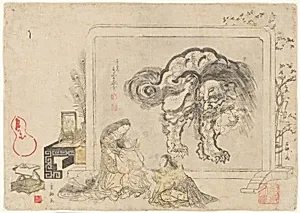
唐獅子図の衝立 |Mother and her Children in Front of a Freestanding Screen of a Chinese Lion
Toriyama Sekien 鳥山石燕|Kitagawa Utamaro 喜多川歌麿|Toriyama Sekichūjo 鳥山石仲女, 1786
About this artwork
In the vibrant world of Edo-period Japan (1615–1868 this 1786 woodblock print, *Mother and her Children in Front of a Freestanding Screen of a Chinese Lion (唐獅子図の衝立), captures a tender domestic moment. Created as a luxurious *surimono*—a privately commissioned print often exchanged as a New Year's greeting—it features the talents of three ukiyo-e masters:iyama Sekien, renowned for his supernatural illustrations and mentorship of many artists; his student Kitagawa Utamaro celebrated for his exquisite bijin-ga (images of beautiful women); and Toriyama Sekichūjo, likely Sekien's daughter. Printed in ink and color on paper in the horizontal ōban format (10 7/8 × 15 3/8 in.), it exemplifies the collaborative artistry of woodblock printing, where designers, carvers, and printers worked in harmony. The scene depicts a graceful mother and her playful children gathered before an ornate freestanding screen adorned with a fierce yet majestic Chinese lion (*karajishi*), a symbol of protection and imperial power borrowed from Chinese iconography and popular in Japanese decorative arts. These screens, or *byeobu*, were status symbols in affluent homes, blending everyday family life with mythical grandeur—a hallmark of ukiyo-e's "floating world" aesthetic, which romanticized beauty and transience. This rare collaborative *surimono* highlights the innovative spirit of late 18th-century Japanese printmaking, where personal commissions allowed for embossing, mica, and vibrant pigments not common in mass-produced works. Now in the Metropolitan Museum of Art's Asian Art collection, it invites us to appreciate the warmth of familial bonds amid artistic splendor.