
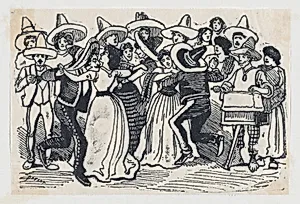
A ball, scene from the Mexican Revolution
ca. 1911
Medium
Zincograph
Dimensions
Sheet: 3 3/8 × 4 15/16 in. (8.5 × 12.5 cm)
Classification
Prints
Department
Drawings and Prints
Museum
Metropolitan Museum of Art, New York, NY
Credit
Gift of Jean Charlot, 1930
Accession Number
30.82.13
Rights
Public Domain
Tags
Art Historical Context
José Guadalupe Posada’s *A Ball, Scene from the Mexican Revolution* captures a lively moment of social gathering amid the turmoil of early 20th-century Mexico. Created around 1911, during the height of the revolutionary conflict, the small zincograph depicts men and women dancing together, offering a glimpse into everyday life and fleeting joys even as political upheaval reshaped the nation. Posada, a prolific printmaker from Aguascalientes, used his art to document and comment on contemporary events for a broad audience. As a zincograph—a relief printing technique that allowed for quick, affordable reproduction on zinc plates—this work exemplifies Posada’s signature approach. He produced thousands of such images for newspapers, broadsides, and flyers, making art accessible beyond elite galleries. The compact size, just over three by five inches, suggests it was designed for widespread circulation rather than museum display. Today in the Metropolitan Museum of Art’s collection, the print highlights Posada’s role in shaping Mexican visual culture. His energetic scenes of dancers, revolutionaries, and everyday figures helped define a distinctly popular graphic tradition that influenced later generations of artists.
About the Artist
José Guadalupe Posada · 1852–1913
José Guadalupe Posada (1852-1913) was a Mexican printmaker and engraver who revolutionized popular art and created some of the most iconic images in Mexican culture. Working primarily with publisher Antonio Vanegas Arroyo, he produced over 20,000 images during his career—inexpensive broadsheets sold for a penny on colored paper that made his art accessible to even the poorest workers. He transform...