
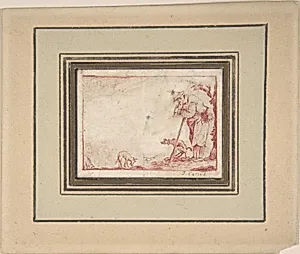
A Beggar Playing a Flute
early 17th century
Medium
Pen and red ink, graphite underdrawing
Dimensions
2 9/16 x 3 7/16 in. (6.5 x 8.7 cm.)
Classification
Drawings
Department
Drawings and Prints
Museum
Metropolitan Museum of Art, New York, NY
Credit
Gift of Harry G. Friedman, 1958
Accession Number
58.651.74
Rights
Public Domain
Tags
Art Historical Context
In the early 17th century, artist Jacques Callot captured gritty vibrancy of everyday life with masterful drawings like *A Beggar Playing aute*. This intimate sheet, measuring just 2 9/16 x 3 7/16 inches, depicts a ragged figure immersed in music, flute to his lips, accompanied by loyal dog—a poignant nod to the marginalized beggars who populated Europe's streets during the Baroque era. Callot, renowned for his empathetic yet unflinching portrayals of the lower classes, drew from life in his native Lorraine and travels across Italy, infusing his works with lively energy and social commentary. Rendered in pen and red ink over a precise graphite underdrawing, the piece showcases Callot's virtuoso technique: fluid lines that convey movement and texture, from the beggar's tattered clothes to the dog's alert fur. Red ink, with its warm, earthy tones, adds depth and immediacy, typical of preparatory sketches that often informed his famous etched series like *Les Gueux* (The Beggars). Housed in the Metropolitan Museum of Art's Drawings and Prints department as a gift from Harry G. Friedman in 1958, this work highlights the artistry of small-scale drawings, valued for their spontaneity and insight into 17th-century urban poverty. Callot's focus on music amid hardship underscores the resilience of the human spirit, making this drawing a window into Baroque humanism and the era's fascination with genre scenes.
About the Artist
Jacques Callot · 1592–1635
Jacques Callot (1592–1635) was a French printmaker and draftsman from the Duchy of Lorraine, widely regarded as one of the first great artists to practice the graphic arts exclusively. His more than 1,400 etchings chronicled the breadth of 17th-century life, from Medici court festivities to the brutal realities of warfare. Callot revolutionized etching through technical innovations including the é...