
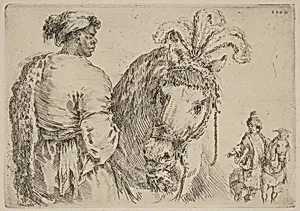
A Black Man Feeding a Horse
probably 1662
Medium
etching on laid paper [restrike]
Classification
Department
CG-E
Museum
National Gallery of Art, Washington, D.C.
Credit
Transferred from The Library of Congress
Accession Number
1986.50.82
Rights
Public Domain
Art Historical Context
Stefano della Bella, a masterful 17th-century Italian printmaker (1610–1661), *A Black Man Feeding a* around 1662, likely as one of his final works before his death. This etching on laid paper—a restrike pulled from the original plate after the artist's lifetime—exemplifies his Baroque style, known for intricate line work and dynamic compositions. Della Bella, who trained in Florence and worked in Paris and Rome, specialized in small-scale prints that captured everyday life with remarkable detail and energy, blending realism with theatrical flair. The medium of etching was revolutionary in Della Bella's era, allowing for fluid, expressive lines etched into a metal plate with acid, then inked and pressed onto paper. His technique shines here, rendering the horse's muscular form, the man's attentive gesture, and subtle textures like hay and folds in clothing with exquisite precision. Such genre scenes elevated ordinary moments to poetic heights, reflecting the Baroque interest in movement and human-animal bonds. This print holds cultural intrigue as a rare 17th-century European depiction of a Black figure in a dignified, everyday role—possibly a stable hand—amidst an era of expanding global trade and diverse urban encounters. Housed in the National Gallery of Art's print collection (transferred from the Library of Congress), it invites visitors to ponder representation and artistry in historical context.
About the Artist
Stefano Della Bella · 1610–1664
Stefano della Bella (1610-1664) was one of the most prolific and versatile printmakers of the Italian Baroque period, leaving behind 1,052 prints and several thousand drawings that captured the vivid essence of 17th-century European life. Born in Florence on May 18, 1610, to a family of artists, he trained initially as a goldsmith before studying painting under Cesare Dandini and etching under Rem...