
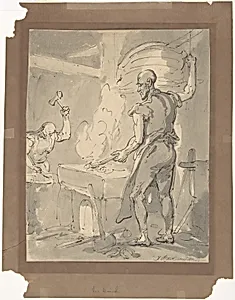
A Blacksmith
18th–19th century
Medium
Pen and black ink, brush and gray wash
Dimensions
sheet: 9 5/8 x 7 1/2 in. (24.4 x 19.1 cm)
Classification
Drawings
Department
Drawings and Prints
Museum
Metropolitan Museum of Art, New York, NY
Credit
Bequest of Hildegarde D. Becher, 1995
Accession Number
1995.123
Rights
Public Domain
Tags
Art Historical Context
Thomas Rowlandson's *A Blacksmith*, created in the late 18th or early 19th century, captures the rugged essence of everyday labor in Georgian Britain through pen and black ink heightened with brush and gray wash. This intimate drawing, measuring 9⅝ × 7½ inches, showcases Rowlandson's signature satirical flair, transforming a simple scene of a male blacksmith at work into a vivid snapshot of working-class life. Housed in the Metropolitan Museum of Art's Drawings and Prints department, it entered the collection via the 1995 bequest of Hildegarde D. Becher. Rowlandson, a prolific British caricaturist and illustrator, was renowned for his humorous, often exaggerated depictions of society—from highborn eccentrics to humble tradesmen. Active during a time of rapid industrialization, his works like this one offer historical insight into the blacksmith's pivotal role: forging tools, horseshoes, and machinery that powered the era's economy and expansion. The medium's loose, expressive lines and subtle gray washes lend dynamic energy and depth, emphasizing movement and texture without the finish of oil painting. This technique highlights Rowlandson's mastery in quick, observational sketches, making *A Blacksmith* a charming window into 18th–19th-century craftsmanship and the artist's keen eye for human character.
About the Artist
Thomas Rowlandson · 1756–1827
Thomas Rowlandson (1757–1827) was an English artist and caricaturist whose satirical watercolors and prints captured the social life of Georgian Britain with unparalleled wit and technical mastery. Alongside James Gillray, he is recognized as one of the greatest British graphic artists, and his distinctive flowing line and keen observations have made his work integral to understanding late 18th an...