
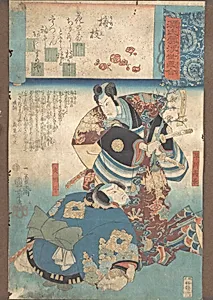
A Branch of Plum (Umegoe)
ca. 1845–46
Medium
Woodblock print; ink and color on paper
Dimensions
13 1/2 x 9 in. (34.3 x 22.9 cm)
Classification
Prints
Culture & Period
Japan · Edo period (1615–1868)
Department
Asian Art
Museum
Metropolitan Museum of Art, New York, NY
Credit
Gift of Judith Underwood Stewart, in memory of Martha Davenport Heard, 2001
Accession Number
2001.612.1
Rights
Public Domain
Tags
Art Historical Context
**A Branch of Plum (Umegoe)** by Utagawa Kuniyoshi (1797–1861) captures the vibrant world of Edo-period Japan (1615–1868), a time when woodblock prints like ukiyo-e flourished as affordable art for the masses. Created around 1845–46, this print belongs to Kuniyoshi's renowned musha-e series, featuring dynamic warrior portraits. The title "Umegoe," meaning "plum branch cry," evokes poetic imagery—plum blossoms symbolize endurance in Japanese culture—while tags of swords and men suggest a fierce samurai or kabuki actor in dramatic pose, blending heroism with theatrical flair. Kuniyoshi, a master of the ukiyo-e ("pictures of the floating world") movement, was celebrated for his bold compositions, imaginative details, and subtle humor, often pushing censorship boundaries with political satire. Printed with ink and color on paper (13 1/2 x 9 in.), the medium highlights the woodblock technique: artisans carved separate blocks for each color, registering them precisely for vivid, layered effects. This innovation made intricate art accessible, influencing global artists like Van Gogh. Housed in the Metropolitan Museum of Art's Asian Art Department (gift of Judith Underwood Stewart, 2001), this piece reflects Edo Japan's cultural boom—merchants patronizing prints of heroes amid urban entertainment. Visitors, imagine the streets alive with such images, inspiring tales of valor!
About the Artist
Utagawa Kuniyoshi · 1797–1861
Utagawa Kuniyoshi (1797–1861) was born in Edo to the silk-dyer Yanagiya Kichiyemon, originally bearing the childhood name Yoshisaburō. From a young age, he assisted in his family's pattern design work, which sharpened his innate mastery of color and textile motifs that would permeate his later prints. At around twelve years old, his prodigious drawing skills drew the attention of the renowned Utag...