
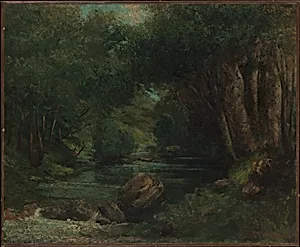
A Brook in the Forest
ca. 1868–77
Medium
Oil on canvas
Dimensions
19 7/8 x 24 1/8 in. (50.5 x 61.3 cm)
Classification
Paintings
Department
European Paintings
Museum
Metropolitan Museum of Art, New York, NY
Credit
Gift of Ralph Weiler, 1967
Accession Number
67.212
Rights
Public Domain
Tags
Art Historical Context
Gustave Courbet's *A Brook in the Forest*ca. 1868–77) captures the raw beauty of nature in the artist's native Franche-Comté region of. As a pioneer of Realism, Courbet rejected the idealized landscapes of Romanticism, instead painting directly from observation to depict the unvarnished truth of the everyday world. This oil on canvas, measuring just under 20 by 24 inches, invites viewers into a dense forest glade where a sparkling brook through mossy rocks and lush foliage, evoking a sense of quiet introspection amid the wilderness. Courbet's masterful technique shines here: his signature impasto—thick layers of pigment applied with a palette knife—gives the bark, leaves, and water a tactile, almost three-dimensional quality. The dramatic play of light filtering through the canopy highlights his commitment to optical accuracy over fantasy, influencing later Impressionists like Monet. Created late in his career, amid personal and political turmoil (he'd later face exile for his role in the 1871 Paris Commune), this work reflects his enduring passion for the French countryside. Today, this intimate landscape graces the Metropolitan Museum of Art's European Paintings collection, a gift from Ralph Weiler in 1967. It reminds us why Courbet's bold Realism revolutionized art, making nature's humble details profound and accessible.
About the Artist
Gustave Courbet · 1819–1877
Jean Désiré Gustave Courbet (1819-1877) was a French painter who revolutionized 19th-century art as the founding figure of the Realism movement. Born in Ornans, a small town in the Doubs region of France, Courbet came from a prosperous farming family with anti-monarchical roots—his maternal grandfather had participated in the French Revolution. This background shaped his lifelong commitment to dep...