
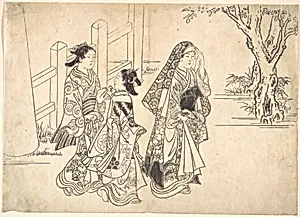
A Courtesan Followed by Two Girl Attendants
1671–1751
Medium
Monochrome woodblock print; ink on paper
Dimensions
14 1/2 x 10 1/4 in. (36.8 x 26 cm)
Classification
Prints
Culture & Period
Japan · Edo period (1615–1868)
Department
Asian Art
Museum
Metropolitan Museum of Art, New York, NY
Credit
Henry L. Phillips Collection, Bequest of Henry L. Phillips, 1939
Accession Number
JP2755
Rights
Public Domain
Tags
Art Historical Context
In the vibrant world of Edo-period Japan (1615–1868), Nishikawa Sukenobu1671–1751) captured the allure of urban life through his masterful ukiyo-e prints, often celebrating the "floating world" of pleasure and beauty. *A Courtesan Follow by Two Girl Attendants a delicate monochrome woodblock print in ink on paper (measuring 14½ × 10¼ inches), exemplifies his skill in bijin-ga, or pictures of beautiful women. Created during a time when woodblock printing democratized art for the growing merchant class, this intimate work from the Metropolitan Museum of Art's Henry L. Phillips Collection highlights the elegance of Yoshiwara courtesans—high-status entertainers whose refined demeanor symbolized sophistication. The scene unfolds with a poised courtesan gliding forward, trailed by two young attendants amid subtle hints of trees, evoking a garden or street procession. Monochrome sumizuri-e technique, using nuanced shades of gray ink, creates depth and movement through expert line work and subtle gradations, a precursor to the later polychrome masterpieces of ukiyo-e masters like Utamaro. This print reflects Edo society's fascination with fashion, hierarchy, and feminine grace, offering a window into the cultural splendor of 18th-century Japan. (198 words)
About the Artist
Nishikawa Sukenobu · 1671–1751
Japanese, 1671–1750