
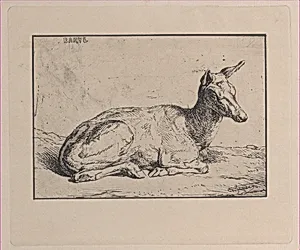
A Doe, after Barye
Medium
Etching
Dimensions
Sheet: 5 13/16 × 8 1/16 in. (14.8 × 20.5 cm) Plate: 4 3/4 × 5 11/16 in. (12 × 14.5 cm)
Classification
Prints
Department
Drawings and Prints
Museum
Metropolitan Museum of Art, New York, NY
Credit
The Elisha Whittelsey Collection. The Elisha Whittelsey Fund, 1963
Accession Number
63.625.437a
Rights
Public Domain
Art Historical Context
In the Prints and Drawings department of the Metropolitan of Art, *A Doe, after Barye* (1846) showcases the delicate artistry of French etcher Charles Jacque, who faithfully reproduced a design by renowned sculptor Antoine-Louis Bary. This intimate etching, measuring just 4¾ × 5⅝ inches on the plate, captures the graceful form of a doe with remarkable precision, highlighting Jacque's skill in translating Barye's sculptural vision into two dimensions. Barye, a pioneer of the animalier style—realistic depictions of wildlife inspired by Romantic naturalism—elevated animals from mere motifs to noble subjects, influencing generations of artists during France's mid-19th-century artistic shift toward realism. Etching, Jacque's chosen medium, involved incising lines into a metal plate with acid, allowing for fine textures like the doe's soft fur and alert posture. Produced in 1846 amid the Barbizon school's embrace of nature, this print reflects the era's fascination with the wild, unromanticized beauty of animals, bridging sculpture and printmaking. Part of The Elisha Whittelsey Collection, it invites visitors to appreciate how such modest works democratized access to elite sculpture, making Barye's dynamic menagerie available to a wider audience. Though small, this piece embodies the technical virtuosity and cultural reverence for nature that defined French Romanticism, offering a serene window into 19th-century artistic collaboration.
About the Artist
Charles Jacque|Antoine-Louis Barye · 1813–1894
Charles-Émile Jacque (1813–1894) was a pioneering French painter, engraver, and illustrator whose career bridged the worlds of printmaking and pastoral painting. Born in Paris amid a difficult childhood, he apprenticed at age seventeen to a map engraver, mastering drypoint technique and producing his first etching in 1830—a copy of a head after Rembrandt. After serving seven years in the French Ar...