
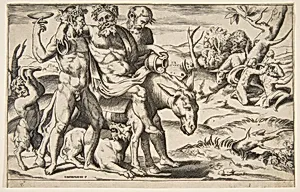
A drunken Silenus riding an ass being supported by satyrs
1531–76
Medium
Engraving
Dimensions
Sheet: 5 1/2 × 8 11/16 in. (14 × 22 cm)
Classification
Prints
Department
Drawings and Prints
Museum
Metropolitan Museum of Art, New York, NY
Credit
Purchase, Joseph Pulitzer Bequest, 1917
Accession Number
17.50.16-93
Rights
Public Domain
Tags
Art Historical Context
Giulio Bonasone’s engraving captures a lively scene from classical mythology, showing the drunken Silenus—companion to the god Bacchus—precariously riding a donkey while satyrs steady him on either side. Created sometime between 1531 and 1576, the small printjust 14 by 22 centimeters) brings together humor and movement in a compact composition. Bonasone, an Italian printmaker active during the Renaissance, specialized in such mythological subjects, drawing on ancient tales to appeal to educated collectors of his day. The theme reflects the Renaissance fascination with Greco-Roman stories, where Silenus embodied both wisdom and excess. Satyrs, with their playful yet wild nature, often appear in art as symbols of unrestrained joy and the natural world. By choosing this moment of comic vulnerability, the artist invites viewers to reflect on the lighter side of mythology while showcasing his skill in rendering expressive figures and dynamic poses. As an engraving, the work highlights the medium’s importance in the 16th century. The precise lines allowed Bonasone to reproduce fine details that could be printed and shared widely, helping spread classical imagery beyond palace walls. Today, this print in the Metropolitan Museum’s collection offers a charming window into how Renaissance artists reimagined ancient legends for new audiences.
About the Artist
Giulio Bonasone · 1500–1600
Comment on works: History; Mythology