
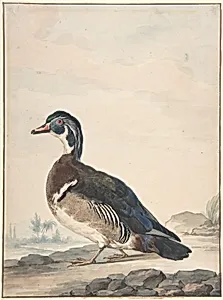
A Duck
mid-17th–late 17th century
Medium
Watercolor and gouache
Dimensions
sheet: 14 x 10 1/2 in. (35.6 x 26.7 cm)
Classification
Drawings
Department
Drawings and Prints
Museum
Metropolitan Museum of Art, New York, NY
Credit
Purchase, Renée Sacks Bequest, 2004
Accession Number
2004.304
Rights
Public Domain
Tags
Art Historical Context
In the mid-to-late 17th century, Dutch artist Aert Schouman created this intimate study of a duck during the Dutch Golden Age, a period marked by expanding interest in natural history and scientific illustration. Schouman specialized in detailed depictions of birds and animals, often working from life or specimens to document species with remarkable accuracy. His works reflect the era’s blend of artistic skill and empirical observation, as collectors and scholars sought to catalog the natural world. Schouman used watercolor and gouache on paper, a medium well-suited for capturing delicate plumage and subtle color variations. The translucent layers of watercolor allow light to create depth, while gouache adds opacity for highlights and fine textures, resulting in a lifelike yet decorative quality. At 14 by 10½ inches, the sheet likely formed part of a larger series of avian studies, valued both for their aesthetic appeal and as references for naturalists. Acquired by the Metropolitan Museum of Art in 2004, “A Duck” invites viewers to appreciate how 17th-century artists bridged art and science. Its presence in the Drawings and Prints department underscores the enduring charm of these precise, engaging portrayals of everyday wildlife.
About the Artist
Aert Schouman · 1710–1792
Comment on works: Portraits; Interiors; Landscapes; Still life