
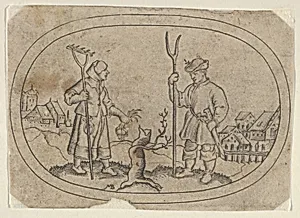
A Farmer and a Villager, from Das Bossenbüchlein
ca. 1582
Medium
Engraving
Dimensions
Sheet: 2 3/8 × 3 5/16 in. (6.1 × 8.4 cm)
Classification
Prints|Ornament & Architecture
Department
Drawings and Prints
Museum
Metropolitan Museum of Art, New York, NY
Credit
The Elisha Whittelsey Collection, The Elisha Whittelsey Fund, 1955
Accession Number
55.503.18(4)
Rights
Public Domain
Tags
Art Historical Context
Step into the lively world of 16th rural Europe with *A Farmer and a Vill*, a delicate engraving from *Das Bossenbchlein* (The Little Book of Peasants), created around 1582 by Mathais Beitler Stephan Herman. This tiny print, measuring just 2 3/8 × 3 5/16 inches, captures a man and woman—likely a farmer and villager—in an intimate exchange, reflecting the everyday textures of peasant life. Produced in the late Renaissance era, such works often appeared in illustrated books documenting social types, trades, and regional customs across Northern Europe. Engravings like this were revolutionary for their reproducibility, allowing intricate details to be shared widely through printed volumes. Beitler and Herman's technique—incising lines into a metal plate with a burin—brings out expressive faces, rustic clothing, and subtle gestures, blending genre realism with ornamental flair (as noted in its classification under Prints: Ornament & Architecture). These images served both artistic and cultural purposes, offering viewers a window into agrarian society amid the era's social upheavals, like the Peasants' Wars decades earlier. Housed in the Metropolitan Museum of Art's Elisha Whittelsey Collection, this piece invites us to appreciate how small-scale prints preserved vanishing folk traditions, making high art accessible to all. A charming snapshot of humanity's timeless rhythms!