
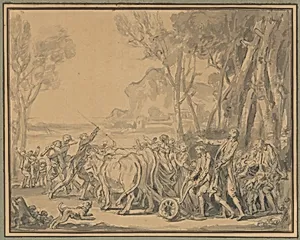
A Farmer Entrusting the Plow to His Son
Jean-Baptiste Greuze, n.d.
About this artwork
In Jean-Baptiste Greuze's drawing *A Farmer Entrusting the Plow to His Son*, we witness a poignant moment of rural legacy. The French artist, active in the late 18th century during the transition from Rococo Neoclassicism, specialized in sentimental genre scenes that celebrated moral virtues, family bonds, and the honest labors of the countryside. Here, a weathered farmer passes the plow to his young son amid cows, dogs, and sturdy trees, symbolizing the timeless transmission of tradition and hard work from one generation to the next—a theme Greuze often explored to evoke empathy and nostalgia in urban audiences. Rendered in brush and gray wash over graphite, with framing lines in pen and brown ink and subtle graphite squaring for transfer, this preparatory sheet showcases Greuze's mastery of monochrome techniques. The fluid washes create soft tonal depth and emotional intimacy, typical of 18th-century draftsmanship used for studies or engravings. A figure sketch on the mount's verso hints at the artist's iterative process, blending observation with idealized pathos. Acquired by The Metropolitan Museum of Art in 1983 through the Van Truex Day Fund, this 15 7/16 x 19 1/2-inch drawing (39.2 x 49.5 cm) captures the cultural reverence for agrarian life in pre-Revolutionary France, reminding us of art's power to honor everyday heroism.