
A Farrier's Shop
1648
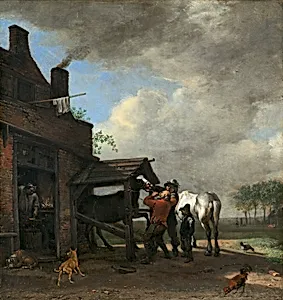
Medium
oil on panel
Dimensions
overall: 48.3 x 45.7 cm (19 x 18 in.) framed: 71.12 × 68.58 × 7.62 cm (28 × 27 × 3 in.)
Classification
Painting
Department
CNE-B
Museum
National Gallery of Art, Washington, D.C.
Credit
Widener Collection
Accession Number
1942.9.52
Rights
Public Domain
Art Historical Context
Paulus Potter’s *A Farrier’s Shop* (1648) captures a quiet moment of everyday rural life in the Dutch Republic during its Golden Age. At just twenty-three, Potter had already established himself as a master of animal painting, and this small oil-on-panel work reflects the period’s growing interest in genre scenes that celebrated ordinary trades and the natural world. Farriers—skilled blacksmiths who shod horses—were essential figures in seventeenth-century communities, and Potter’s choice of subject highlights both the economic importance of horses and the dignity of manual labor. Painted with meticulous attention to texture and light, the panel’s smooth surface allowed Potter to render the sheen of metal tools, the rough coats of animals, and the play of sunlight across the workshop with remarkable clarity. Such intimate scale invites close viewing, a hallmark of Dutch cabinet paintings meant for private collectors rather than grand public spaces. Today in the National Gallery of Art’s Widener Collection, the painting offers modern visitors a vivid glimpse into seventeenth-century Dutch society, where art transformed the ordinary routines of village life into enduring scenes of harmony between humans, animals, and their environment.
About the Artist
Paulus Potter · 1625–1654
Paulus Potter (1625–1654) was a Dutch Golden Age painter whose short life — he died at just twenty-eight years of age — belied an artistic achievement of remarkable originality and influence. Born in Enkhuizen in 1625, Potter trained under his father, the painter Pieter Potter, and later in Amsterdam and Delft, where he absorbed the technical standards of the flourishing Dutch painting tradition. ...