
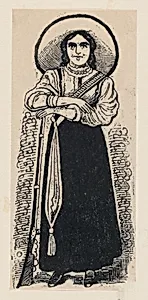
A female soldier standing
ca. 1880–1910
Medium
Zincograph
Dimensions
Sheet: 5 11/16 × 2 9/16 in. (14.5 × 6.5 cm)
Classification
Prints
Department
Drawings and Prints
Museum
Metropolitan Museum of Art, New York, NY
Credit
Gift of Jean Charlot, 1930
Accession Number
30.82.97
Rights
Public Domain
Tags
Art Historical Context
In the Prints collection of The Metropolitan Museum of Art, Guadalupe Posada's *A Female Soldier Standing* (ca. 1880–1910) captures a portrait of a woman in military attire. This small zincograph, measuring just 5 11/16 × 2 9/16 inches, exemplifies Posada's mastery of affordable, mass-produced imagery during Mexico's turbulent late 19th and early 20th centuries. Pos, a pioneering Mexican printmaker (1852–1913), was renowned for his bold, satirical broadsheets that blended folk art with social commentary, often produced via zincography—a relief printing technique using zinc plates for sharp lines and high-volume reproduction. The artwork's depiction of a standing female soldier reflects the era's shifting gender roles, evoking the *soldaderas*—fierce women who supported and fought in Mexico's revolutionary struggles. Posada's stark, linear style, influenced by popular graphics and European caricature traditions, democratized art, making political and cultural narratives accessible to everyday people through newspapers and flyers. This intimate print, gifted to the Met in 1930 by artist Jean Charlot, underscores Posada's enduring legacy in Mexican visual culture, celebrating resilience amid historical upheaval.
About the Artist
José Guadalupe Posada · 1852–1913
José Guadalupe Posada (1852-1913) was a Mexican printmaker and engraver who revolutionized popular art and created some of the most iconic images in Mexican culture. Working primarily with publisher Antonio Vanegas Arroyo, he produced over 20,000 images during his career—inexpensive broadsheets sold for a penny on colored paper that made his art accessible to even the poorest workers. He transform...