
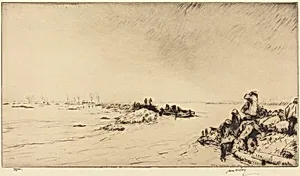
A Flood in the Fens
1922
Medium
drypoint
Dimensions
sheet (irreg.): 26.8 × 40.3 cm (10 9/16 × 15 7/8 in.)
Classification
Department
CG-W
Museum
National Gallery of Art, Washington, D.C.
Credit
Rosenwald Collection
Accession Number
1943.3.6030
Rights
Public Domain
Art Historical Context
James McBey's *A Flood in the F* (1922) captures a dramatic moment in England's low-lying Fenlands, a region notorious for its vast marshes and recurring floods. The Scottish artist, renowned for his masterful prints, traveled extensively to depict atmospheric landscapes with a keen eye for light and texture. Created just after World War I, work reflects McBey's post-war focus on the natural world's quiet power, contrasting human vulnerability with expansive waterways and sodden fields. Rendered in drypoint—a direct intaglio technique where a sharp tool scratches into a metal plate, raising a soft burr for rich, velvety lines—this print exemplifies McBey's virtuosity. Unlike etched lines, drypoint's tactile burr yields fewer impressions but intense depth and immediacy, perfectly suiting the flood's swirling chaos and reflective surfaces. Measuring about 10 9/16 × 15 7/8 inches on an irregular sheet, its intimate scale draws viewers into the scene's moody tension. Housed in the National Gallery of Art's Rosenwald Collection, this print highlights early 20th-century British printmaking's golden age, blending realism with impressionistic subtlety. McBey's Fens evoke both ecological peril and timeless beauty, inviting us to ponder humanity's fragile harmony with nature.
About the Artist
James McBey · 1883–1959
James McBey (1883–1959) was a Scottish artist renowned for his etchings and paintings, emerging from humble beginnings in Newburgh, Aberdeenshire, as the illegitimate son of a blacksmith's daughter. Largely self-taught, he left school at fifteen to work as a bank clerk in Aberdeen, where he devoured art books from the public library and attended evening classes at Gray's School of Art to hone his ...