
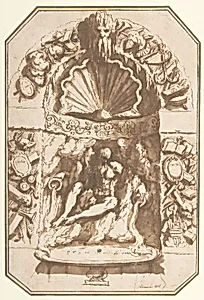
A Fountain in a Grotto
ca. 1598
Medium
Pen and brown ink, brush and brown wash, over traces of black and red chalk
Dimensions
maximum, corners cut to octagonal shape: 10 3/4 × 7 1/4 in. (27.3 × 18.4 cm)
Classification
Drawings|Ornament & Architecture
Department
Drawings and Prints
Museum
Metropolitan Museum of Art, New York, NY
Credit
Purchase, James A. and Maria R. Warth Gift, in memory of Anne and Peter Warth, 1999
Accession Number
1999.63
Rights
Public Domain
Tags
Art Historical Context
**A Fountain in a Grotto is a captivating preparatory drawing by Giovanni Guerra, an Italian artist active in late 16th-century Rome, created around 1598. Executed in pen and brown ink with brush and brown wash over traces of black and red, this work exemplifies the meticulous techniques of Renaissance draftsmanship. The sheet's unusual octagonal shape—its corners trimmed to a maximum of 10 3/4 × 7 1/4 inches—suggests it was customized for an album or presentation, a common practice for ornamental designs shared among patrons and fellow artists. Guerra specialized in grotesque and architectural fantasies, drawing from the whimsical Mannerist tradition inspired by ancient Roman decorations unearthed during the Renaissance. This depiction of a fountain nestled in a rocky grotto, featuring male figures amid cascading water, reflects the era's fascination with artificial grottos and hydraulic marvels in elite gardens, such as those at the Villa d'Este. As a study in the Met's Drawings and Prints department, it highlights the architectural ornamentation that bridged painting, sculpture, and landscape design. Acquired in 1999 through a generous gift, this piece invites visitors to appreciate the ingenuity behind Renaissance spectacle—where ink and wash conjured watery illusions meant to delight and astonish. A window into Guerra's inventive world, it underscores how such drawings fueled the opulent fantasies of papal and noble courts.