
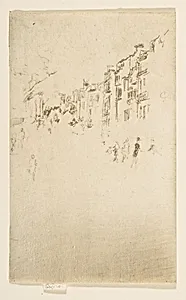
A Fragment of Piccadilly (Piccadilly)
[1884–86]
Medium
Etching, printed in dark brown ink on ivory laid paper; only state (Glasgow)
Dimensions
Plate: 4 1/4 × 2 5/8 in. (10.8 × 6.7 cm) Sheet: 4 1/4 × 2 5/8 in. (10.8 × 6.7 cm)
Classification
Prints
Department
Drawings and Prints
Museum
Metropolitan Museum of Art, New York, NY
Credit
Harris Brisbane Dick Fund, 1917
Accession Number
17.3.134
Rights
Public Domain
Tags
Art Historical Context
James McNeill Whistler, renowned American-born artist celebrated for his Aestheticist principles and mastery of tone and harmony, created *A Fragment of Piccadilly (Piccadilly)* between 1884 and 1886. This intimate etching captures a glimpse of London's vibrant Piccadilly district—a bustling hub of Regency-era architecture, shops, and urban energy—rendered in a single state from the Glasgow edition. Printed in dark brown ink on delicate ivory laid paper, its diminutive size (just 4¼ × 2⅝ inches) invites close contemplation, transforming a street scene into a poetic fragment of modern city life. Whistler's etching technique exemplifies his innovative printmaking, where he used fine lines and subtle aquatint-like textures to evoke atmosphere rather than precise detail. Influenced by his earlier Thames and Venice series, this work reflects his shift toward capturing everyday London motifs with a Japanese-inspired focus on composition and mood. Etchings like this were affordable multiples, democratizing art while showcasing Whistler's technical virtuosity in controlling ink tone on the plate. Housed in the Metropolitan Museum of Art's Drawings and Prints department (acquired via the Harris Brisbane Dick Fund in 1917), *A Fragment of Piccadilly* highlights Whistler's enduring legacy in bridging painting and printmaking, offering visitors a window into 19th-century London's architectural splendor and the artist's subtle artistry.
About the Artist
James McNeill Whistler · 1834–1903
James Abbott McNeill Whistler (1834-1903) was an American-born painter and printmaker who became a leading figure in the Aesthetic Movement and pioneer of Tonalism and Japonisme. He revolutionized art by championing "art for art's sake" and treating paintings as visual equivalents of musical compositions, titling works as "arrangements," "harmonies," and "nocturnes" to emphasize formal qualities o...