
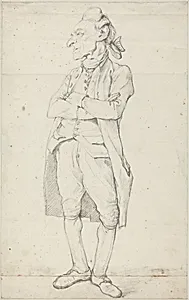
A Gentleman Standing with His Arms Crossed
1726 to 1750
Medium
black chalk on 2 joined sheets of laid paper
Dimensions
overall: 37.8 x 23.7 cm (14 7/8 x 9 5/16 in.)
Classification
Drawing
Department
CG-E
Museum
National Gallery of Art, Washington, D.C.
Credit
Ailsa Mellon Bruce Fund
Accession Number
1998.28.4
Rights
Public Domain
Art Historical Context
In the tranquil galleries of the National Gallery of, *A Gentleman Standing with His Arms Crossed* by François-André Vincent captures moment of poised introspection. Created between 1726 and 1750, this drawing showcases Vincent's skill as a French artist during the Rococo era's transition toward Neoclassicism. The subject—a dignified gentleman with arms firmly crossed—evokes the era's interest in character studies and portraiture, possibly serving as a preparatory sketch for a larger painting. Executed in black chalk on two joined sheets of laid paper, the work measures 37.8 x 23.7 cm, highlighting the artist's masterful use of this versatile medium. Black chalk allowed for subtle tonal gradations and expressive lines, ideal for conveying fabric textures and contemplative posture. The joined sheets suggest an improvisational process, common in 18th-century ateliers where artists pieced together studies to refine compositions. Acquired through the Ailsa Mellon Bruce Fund and housed in the CG-E Department, this drawing offers a glimpse into Vincent's draftsmanship. It invites visitors to appreciate the intimacy of preparatory art, bridging the gap between artist’s hand and finished masterpiece in the refined world of Enlightenment-era portraiture.
About the Artist
François-André Vincent · 1746–1816
French painter and draughtsman. He was one of the principal innovators in French art of the 1770s and 1780s, in the field of both Neo-classical subjects and themes from national history. Comment on works: Portraits; History