
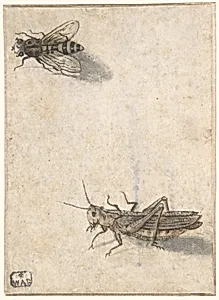
A Grasshopper and a Bee
Medium
Pen and black ink, gray wash, gouache, and watercolor
Dimensions
sheet: 3 5/16 x 2 5/16 in. (8.4 x 5.8 cm)
Classification
Drawings
Department
Drawings and Prints
Museum
Metropolitan Museum of Art, New York, NY
Credit
Bequest of Catherine G. Curran, 2008
Accession Number
2008.425
Rights
Public Domain
Tags
Art Historical Context
Behold *A Grasshopper and a*, a delicate 17th-century (?) drawing attributed variably to the anonymous Dutch or Netherlandish schools, or even the masterful Joris Hoefnagel (1542–1600), a pioneering Flemish artist famed for his meticulous nature studies. Crafted on a tiny sheet measuring just 3 5/16 x 2 5/16 inches, this intimate work captures two insects in exquisite detail using pen and black ink, gray wash, gou, and watercolor—techniques that highlight the era's growing fascination with scientific observation. In the Golden Age of Dutch and Netherlandish art, such drawings emerged from a cultural shift toward natural history, blending artistic virtuosity with proto-scientific precision. Hoefnagel's influence looms large; his illuminations for Emperor Rudolf II's *Mira Calligraphiae Monumenta* set a standard for hyper-realistic depictions of flora and fauna, often symbolizing divine order or moral lessons—like industry (the bee) versus idleness (the grasshopper), echoing Aesop's fables. This piece exemplifies the period's mastery of mixed media on vellum or paper, allowing luminous effects that mimic life's vibrancy. Now in the Metropolitan Museum of Art's Drawings and Prints department, thanks to the 2008 bequest of Catherine G. Curran, it invites visitors to marvel at nature's miniature wonders, reminding us how 16th- and 17th-century artists bridged art and discovery in an age of exploration.