
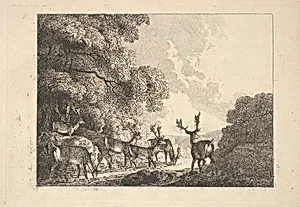
A Group of Stags Drinking
Medium
Etching
Dimensions
Plate: 7 5/16 x 10 7/8 in. (18.6 x 27.7 cm) Sheet: 18 1/2 x 12 3/8 in. (47 x 31.5 cm)
Classification
Prints
Department
Drawings and Prints
Museum
Metropolitan Museum of Art, New York, NY
Credit
Harris Brisbane Dick Fund, 1933
Accession Number
33.7(22)
Rights
Public Domain
Tags
Art Historical Context
### A Group of Stags DrinkingStep into the serene British countryside of the late 18th century withA Group of Stags*, a delicate etching produced between 1784 and 1788 by Thomas Rowlandson and Howitt. Rowlandson, famed for his witty caricatures and satirical scenes of Georgian society, teamed up with Howitt, a master illustrator of sporting life and wildlife, to capture this tranquil moment of majestic stags gathered at a stream amid lush trees. This collaboration reflects the era's fascination with hunting culture, nature's beauty, and the aristocratic pursuit of the hunt, evoking the picturesque landscapes popularized by artists like George Stubbs. The etching medium shines here, with its fine lines etched into a metal plate using acid, allowing intricate details in the deer’s textured fur, rippling water, and leafy foliage. Measuring a modest plate size of 7 5/16 x 10 7/8 inches, the print's larger sheet emphasizes its role as an affordable yet elegant reproduction for collectors. Housed in the Metropolitan Museum of Art's Drawings and Prints department (Harris Brisbane Dick Fund, 1933), it exemplifies how prints democratized access to high art during the Enlightenment, blending observation with artistic finesse. (198 words)
About the Artist
Thomas Rowlandson|Samuel Howitt · 1756–1827
Thomas Rowlandson (1757–1827) was an English artist and caricaturist whose satirical watercolors and prints captured the social life of Georgian Britain with unparalleled wit and technical mastery. Alongside James Gillray, he is recognized as one of the greatest British graphic artists, and his distinctive flowing line and keen observations have made his work integral to understanding late 18th an...