
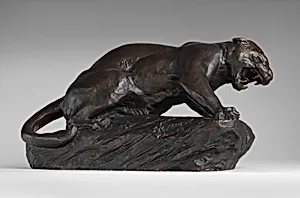
A Jaguar
1885
Medium
Bronze
Dimensions
13 x 9 x 20 in. (33 x 22.9 x 50.8 cm)
Classification
Sculpture
Culture
American
Department
The American Wing
Museum
Metropolitan Museum of Art, New York, NY
Credit
Gift of Mrs. James P. Paulding, 1918
Accession Number
18.80
Rights
Public Domain
Tags
Art Historical Context
In the American Wing of the Metropolitan Museum Art, Edward Kemeys' *A Jaguar* (1885) captures the raw power and sleek ferocity of its namesake predator in gleaming bronze. Measuring just 13 x 9 x 20 inches, this compact sculpture invites close contemplation, its muscular form poised in mid-stride, every sinew and whisker rendered with lifelike precision. Gifted to the Met in 1918 by Mrs. James P. Paulding it exemplifies Kemeys' mastery as a pioneering American animal sculptor during the Gilded Age. Kemeys, often hailed as the "father of American animal sculpture," drew from direct observation of zoo animals in Chicago and Europe, infusing his works with naturalistic vigor that bridged European animalier traditions—like those of Antoine-Louis Barye—with a distinctly American boldness. Created amid a surge of interest in wildlife and realism in late 19th-century art, *A Jaguar* reflects the era's fascination with exotic beasts symbolizing untamed nature and imperial exploration. Bronze, with its enduring patina and ability to convey texture—from glossy fur to taut muscle—lends timeless drama to Kemeys' vision. This piece not only showcases technical prowess in lost-wax casting but also celebrates America's growing artistic confidence, inviting visitors to marvel at the jaguar's predatory grace frozen in metal.