
A Jurist
c. 1550
Medium
bronze
Dimensions
overall: 82 x 71.5 x 34.3 cm (32 5/16 x 28 1/8 x 13 1/2 in.)
Classification
Sculpture
Department
CSD
Museum
National Gallery of Art, Washington, D.C.
Credit
Widener Collection
Accession Number
1942.9.145
Rights
Public Domain
Art Historical Context
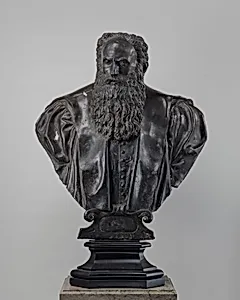
Nestled in the National Gallery Art's Widener Collection *A Jurist* is a striking bronze sculpture attributed to a Paduan artist from the 16th century, dating to around 1550. Hailing from Padua, vibrant hub of Renaissance artistry in northern Italy, this work exemplifies the region's mastery of bronze casting. At over 82 cm tall, the life-sized figure captures a jurist—likely a lawyer or judge—in a dignified pose, reflecting the era's fascination with classical antiquity and humanist ideals. The medium of bronze, prized for its durability and ability to convey rich textures and subtle patinas, allowed sculptors to achieve lifelike realism and emotional depth. Padua's artistic legacy, influenced by masters like Donatello, thrived on innovative foundry techniques that produced both grand public monuments and intimate portraits. This piece, classified as sculpture in the CSD Department, showcases the technical prowess of anonymous workshop traditions, where multiple artists collaborated on detailed modeling and casting. Its imposing dimensions—82 x 71.5 x 34.3 cm—suggest it was designed for a scholarly or civic setting, symbolizing authority and intellect during a time when legal scholars shaped Renaissance society. Today, *A Jurist* invites visitors to ponder the intersection of law, portraiture, and metallurgy in 16th-century Italy, a testament to Padua's enduring contributions to European sculpture.