
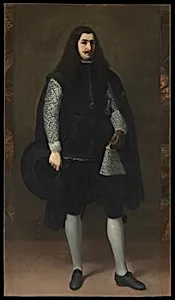
A Knight of Alcántara or Calatrava
Bartolomé Estebán Murillo, ca. 1650–55
About this artwork
Behold *A Knight of Alcántara or Calatrava*, a striking portrait by the renowned Spanish Baroque master Bartolomé Esteban Murillo, painted around 1650–55. Murillo, a leading figure of Seville's Golden Age art scene, captures the noble bearing of a knight from one of Spain's ancient military orders—either the Order of Alcántara Calatrava, both founded during the Reconquista to defend Christendom against Muslim forces in Iberia. These chivalric brotherhoods symbolized valor, piety, and loyalty, and the sitter's imposing stance and ornate armor evoke the era's ideals of heroism. Rendered in oil on canvas, the work showcases Murillo's mastery of dramatic chiaroscuro lighting and lifelike textures, hallmarks of Baroque portraiture that bring the knight's gleaming metal and rich fabrics to vivid life. Originally measuring 77 x 38½ inches, the canvas was later enlarged with added strips to its current 77 x 43¾ inches, a common 19th-century practice to enhance grandeur for display. Now gracing the Metropolitan Museum of Art as a gift from Rudolf J. Heinemann in 1954, this portrait offers a window into 17th-century Spanish nobility and Murillo's versatility beyond his famous religious scenes. It's a testament to enduring chivalric legacy, inviting visitors to ponder the knight's untold stories.