
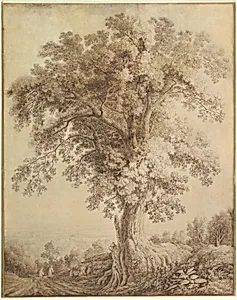
A Large Tree at Albano
Medium
Pen and brown ink, brush and brown wash, over graphite; framing lines in brown ink
Classification
Drawings
Department
Drawings and Prints
Museum
Metropolitan Museum of Art, New York, NY
Credit
Purchase, Mr. and Mrs. David T. Schiff Gift, 1977
Accession Number
1977.418
Rights
Public Domain
Tags
Art Historical Context
### A Large Tree at AlbanoStep into the sun-dappled landscapes of 18th-century Italy with Jacob Philipp Hackert's *A Large Tree at Albano (1782). This drawing captures the majestic form of a solitary tree in Albano, a picturesque town near Rome overlooking Lake Albano. Hackert, a German artist who made Italy his home from 1768 onward, was renowned for his precise, depictions of the Roman countryside. His works appealed to Grand Tour travelers and intellectuals like Goethe, who praised his ability to render nature with topographic accuracy and poetic grace. Rendered in pen and brown ink with brush and brown wash over a subtle graphite underdrawing, the piece showcases Hackert's masterful technique. The fine ink lines define the tree's rugged bark and branching structure, while the brown wash adds soft tonal depth, evoking sunlight filtering through leaves. Framing lines in brown ink give it a polished, autonomous quality, typical of finished landscape studies from the era. This method allowed Hackert to balance meticulous detail with atmospheric effects, bridging neoclassical clarity and emerging Romantic sensibilities. Acquired by The Metropolitan Museum of Art in 1977 through the generous gift of Mr. and Mrs. David T. Schiff, this drawing highlights the enduring allure of nature as artistic muse. It invites visitors to appreciate how Hackert transformed a simple tree into a symbol of Italy's timeless beauty. *(198 words)*
About the Artist
Jacob Philipp Hackert · 1737–1807
German landscape painter, views in Italy; in the manner of Claude. Landscape painter whose international experience and views in the tradition of Claude Lorrain proved highly influential when he settled in Naples in the late 18th century.