
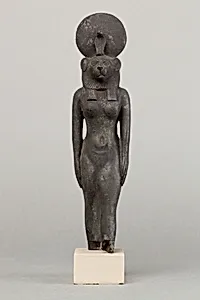
A lion headed goddess, possibly Wadjet
Unknown Artist
664–30 B.C.
Medium
Cupreous metal
Dimensions
H. 18.7 cm (7 3/8 in.); W. 4.6 cm (1 13/16 in.); D. 3.9 cm (1 9/16 in.)
Classification
Statuette, lion-headed goddess, possibly Wadjet
Period
Late Period–Ptolemaic Period
Department
Egyptian Art
Museum
Metropolitan Museum of Art, New York, NY
Credit
Gift of Joseph W. Drexel, 1889
Accession Number
89.2.574
Rights
Public Domain
Tags
Art Historical Context
This striking bronze figurine, titled *A Lion-Headed Goddess, Possiblyjet*, captures the fierce majesty of ancient Egyptian divinity. Standing just 18.7 cm tall, the goddess is depicted with a powerful leonine head, evoking protectors like Sekhmet—the warrior goddess of war and healing—or Wadjet, the guardian of Lower Egypt. Crafted from cupreous metal (a copper-based alloy), its small scale suggests it served as a votive offering, amulet, or personal devotional object, common in households or temples during Egypt's Late Period to Ptolemaic era (664–30 B.C.). Dating to a time of political upheaval under native pharaohs and later Greek Ptolemaic rulers, the sculpture reflects Egypt's enduring religious traditions amid cultural fusion. Lion-headed deities symbolized raw power and protection, channeling the Nile's wild forces to safeguard against chaos. The Ptolemaic influence may appear in refined casting techniques, where molten metal was poured into molds for crisp details like the goddess's mane and poised stance. Housed in the Metropolitan Museum of Art's Egyptian Art department (gift of Joseph W. Drexel, 1889), this artifact invites us to ponder the ancient Egyptians' reverence for divine ferocity—reminding visitors that even small bronzes carried immense spiritual weight in daily life and eternity.