
A Mad Dog in a Coffee House
March 20, 1809
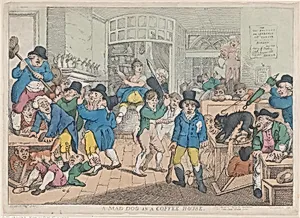
Medium
Hand-colored etching
Dimensions
Sheet: 11 3/16 × 15 9/16 in. (28.4 × 39.5 cm)
Classification
Prints
Department
Drawings and Prints
Museum
Metropolitan Museum of Art, New York, NY
Credit
The Elisha Whittelsey Collection, The Elisha Whittelsey Fund, 1959
Accession Number
59.533.1322
Rights
Public Domain
Tags
Art Historical Context
Thomas Rowlandson’s *A Mad Dog in a Coffee House*1809) is a lively hand-colored etching that captures the chaotic frenzy of Regency-era London society. Published on March 20, this satirical print depicts men and women in a bustling coffee house thrown into pandemonium by a rabid dog—likely a nod to real fears of rabies outbreaks. Rowlandson, a master caricaturist known for his Hogarthian wit, exaggerates facial and tumbling figures to mock human panic and folly amid the era’s social hubs, where coffee houses served as for gossip, politics, and commerce. As a hand-colored etching, the work showcases Rowlandson’s fluid linework and vibrant hues added by hand, enhancing its comedic punch and allowing affordable dissemination to a wide audience. Measuring about 11 by 15 inches, it exemplifies the British satirical print tradition, blending sharp social commentary with grotesque humor. Housed in the Metropolitan Museum of Art’s Drawings and Prints department, this piece from The Elisha Whittelsey Collection highlights how 19th-century artists used prints to critique everyday absurdities, inviting viewers to laugh at their own vulnerabilities.
About the Artist
Thomas Rowlandson · 1756–1827
Thomas Rowlandson (1757–1827) was an English artist and caricaturist whose satirical watercolors and prints captured the social life of Georgian Britain with unparalleled wit and technical mastery. Alongside James Gillray, he is recognized as one of the greatest British graphic artists, and his distinctive flowing line and keen observations have made his work integral to understanding late 18th an...