
A Man in Armor
1401 to 1500
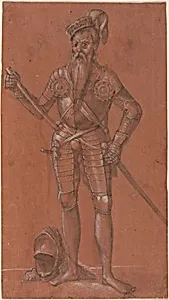
Medium
black chalk, pen and black ink, and gray wash heightened with white on red-orange prepared laid paper
Dimensions
overall: 28.3 x 15.7 cm (11 1/8 x 6 3/16 in.)
Classification
Drawing
Department
CG-E
Museum
National Gallery of Art, Washington, D.C.
Credit
Woodner Collection
Accession Number
2000.25.4
Rights
Public Domain
Art Historical Context
Behold *A Man in Armor*, captivating drawing from the Swiss 16th century, created between 1401 and 1500. This anonymous work, housed in the National Gallery of's Woodner Collection, the meticulous preparatory sketches of the late Northern Renaissance. Measuring just 28.3 x 15.7 cm, it a stoic figure clad in intricate plate armor, likely intended as a study for larger paintings, engravings, or tapestries depicting soldiers or knights. The artist's virtuoso technique shines through a sophisticated mix of media: precise pen and black ink outlines define the armor's rivets and folds, while black chalk and gray wash build volume and shadow. Heightened with white gouache on red-orange prepared laid paper—a favored Renaissance support that provides a warm mid-tone—the drawing achieves dramatic chiaroscuro, mimicking the gleam of metal under light. This method, common among Swiss and German draftsmen like those in the Danube School, allowed for quick yet expressive modeling of form. In the context of 15th-century Switzerland, amid mercenary armies and chivalric ideals, such studies held cultural weight, preserving the evolving designs of Gothic-to-Renaissance armor. Today, it offers a window into an artist's workshop, revealing the blend of observation and imagination that fueled Europe's artistic rebirth.