
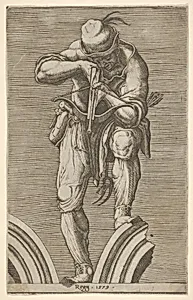
A Man Shooting a Crossbow
Medium
Engraving
Dimensions
Sheet: 8 3/4 × 5 7/8 in. (22.2 × 15 cm)
Classification
Prints
Department
Drawings and Prints
Museum
Metropolitan Museum of Art, New York, NY
Credit
The Elisha Whittelsey Collection, The Elisha Whittelsey Fund, 1949
Accession Number
49.50.234
Rights
Public Domain
Tags
Art Historical Context
Behold *A Man Shooting a Crossbow* (1579), a captivating engraving from the Metropolitan Museum of Art's Drawings and Prints department. Created through a collaboration between Italian Mannerist artists Cherubino Alberti (also known as Zaccaria Mattia), Lelio Orsi (called Lelio da Novellara), and Dutch engraver Cornelis Cort, this intimate sheet measures just 8 3/4 × 5 7/8 inches. Such teamwork was common in the late Renaissance, where painters like Orsi provided dynamic designs that master engravers like Cort translated into precise, reproducible prints. Engraving, the medium here, revolutionized art dissemination in 16th-century Europe by allowing detailed images to be mass-produced from metal plates. Cort's technique captures the tension and motion of the archer mid-shot, with intricate line work conveying musculature, fabric folds, and the curve of the crossbow—hallmarks of Mannerist elegance and anatomical precision. Orsi's influence shines in the figure's poised, almost theatrical stance, evoking classical antiquity while nodding to contemporary hunting and martial culture. This print not only showcases technical virtuosity but also reflects Renaissance fascination with archery as both sport and symbol of prowess. Part of The Elisha Whittelsey Collection, it invites us to admire how these artists bridged Italian innovation and Northern precision, making high art accessible to collectors across Europe.
About the Artist
Cherubino Alberti (Zaccaria Mattia)|Lelio Orsi (called Lelio da Novellara)|Cornelis Cort · 1553–1615
Cherubino Alberti (1553–1615), also known by his birth name Zaccaria Mattia, was an Italian engraver and painter active in Rome during the late Renaissance and early Baroque periods. Born in Borgo San Sepolcro in Tuscany, he came from an artistically inclined family and received training that equipped him for work in both painting and the reproductive graphic arts. It was as a printmaker, however,...