
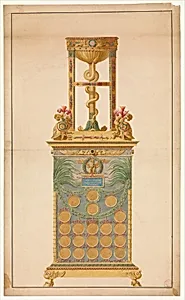
A Medal Cabinet for Napoleon
1804–10
Medium
Pen and ink and watercolor
Dimensions
36 7/8 x 21 7/8 in. (93.7 x 55.6 cm)
Classification
Drawings|Ornament & Architecture
Department
Drawings and Prints
Museum
Metropolitan Museum of Art, New York, NY
Credit
Gift of Mrs. Charles Wrightsman, 1998
Accession Number
1998.7
Rights
Public Domain
Tags
Art Historical Context
Imagine stepping into the opulent world of Napoleonic France with *A Medal Cabinet for Napoleon*, a stunning preparatory drawing by Jean Guillaume Moitte from 1804–10. Created during Napoleon Bonaparte's reign as Emperor, this large-scale pen, ink, and watercolor design (nearly 3 feet tall) depicts an elaborate cabinet intended to house medals—symbols of military glory and imperial prestige. Moitte, a prominent French neoclassical artist known for his sculptures and decorative works, captured the grandeur of the era in this ornament and architecture study, now housed in the Metropolitan Museum of Art's Drawings and Prints department. The composition bursts with symbolic motifs: flowing garlands evoke classical festivity and triumph, coiled snakes suggest eternity or protective emblems like the caduceus, and prominent insignia highlight Napoleonic honors. These elements blend neoclassical restraint with Empire style exuberance, reflecting France's revival of ancient Roman motifs to legitimize Napoleon's rule. As a functional yet luxurious furniture design, it underscores how art served propaganda, showcasing the emperor's achievements in a domestic setting. Moitte's masterful use of pen and ink for precise lines, enhanced by watercolor's subtle color washes, brings the cabinet to life, making this sheet a rare survivor of imperial workshop sketches. A gift to the Met in 1998, it invites us to ponder the artistry behind power.
About the Artist
Jean Guillaume Moitte · 1746–1810
A sculptor and draftsman who worked in the Neoclassical style and, although not that well-known, to be one of France most talented and committed exponents of that style. In 1768 he won the Prix de Rome for sculpture and lived in Rome from October 1771 to May 1773. In 1783 Moitte was accepted by the Académie Royale de Peinture et de Sculpture and received commissions for several statues and low r...