
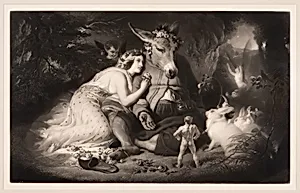
A Midsummer Night's Dream (Shakespeare, Act 4, Scene 1)
November , 1857
Medium
Mixed method engraving with mezzotint on chine collé; second state of three
Dimensions
Plate: 25 11/16 × 37 5/16 in. (65.2 × 94.7 cm) Sheet: 28 7/16 × 38 7/16 in. (72.2 × 97.7 cm)
Classification
Prints
Department
Drawings and Prints
Museum
Metropolitan Museum of Art, New York, NY
Credit
Harris Brisbane Dick Fund, 1947
Accession Number
47.30.46
Rights
Public Domain
Tags
Art Historical Context
Step into the enchanting world of Shakespeare's *A Midsummer Night's Dream* this captivating 1857 print, Act 4, Scene 1. Here, Queen Titania lies spellbound, cradled by the transformed Bottom—his head now that of a donkey—amid a whimsical fairy court featuring rabbits and ethereal women. Sir Edwin Henry Landseer, the renowned Victorian animal painter famous for works like *The Monarch of the Glen*, captures the scene's magical folly with his signature blend of realism and fantasy, evoking the Bard's themes of love, illusion, and nature's whimsy. Master engraver Samuel Cousins brings Landseer's vision to life through a mixed-method engraving with mezzotint on chine collé, in the second state of three. Mezzotint, known as the "black manner," scrapes a roughened copper plate to produce velvety tones and dramatic chiaroscuro, ideal for the print's lush foliage, soft fur, and glowing figures. Chine collé—a thin Chinese paper adhered to a stronger support—ensures fine detail and stability for this large-scale work (plate: 25⅝ × 37⅜ in.). A highlight of the Metropolitan Museum of Art's Drawings and Prints collection, gifted via the Harris Brisbane Dick Fund in 1947, this print reflects mid-19th-century Britain's Shakespeare mania and the prestige of reproductive prints, making high art accessible to a wider audience. It's a delightful nod to how Victorian artists reimagined the immortal playwright through their love of animals and the supernatural.