
古筆切の手鑑 『藻鏡』|A Mirror of Gathered Seaweed (Mokagami)
8th–17th century
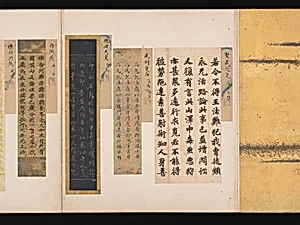
Medium
Album of 301 calligraphy fragments; mostly ink on paper, some on dyed or decorated paper
Dimensions
Album: 15 3/4 × 13 3/8 × 6 5/16 in. (40 × 34 × 16 cm)
Classification
Calligraphy
Culture & Period
Japan · Nara (710–794)–Edo (1615–1868) period
Department
Asian Art
Museum
Metropolitan Museum of Art, New York, NY
Credit
Mary Griggs Burke Collection, Gift of the Mary and Jackson Burke Foundation, 2015
Accession Number
2015.300.229
Rights
Public Domain
Tags
Art Historical Context
Step into the timeless world of Japanese calligraphy withA Mirror of Gatheredweed (Mokagami)*, an exquisite album known as *Furitsu no tegami*. Compiled as a *tegan*—a hand-held manual for calligraphic study—this treasure houses 301 fragments clipped from ancient documents, spanning the Nara period (710–794 to the Edo period (1615–8). Created by various master calligraphers, it Japan's profound reverence for writing as an art form, where brushstrokes convey not just words but rhythm, emotion, and spiritual depth. The album's historical significance lies in its role as a "mirror" for aspiring artists, preserving rare samples of evolving scripts like kaisho (block script) and gyosho (running script). These snippets, salvaged from scrolls, letters, and sutras, capture stylistic shifts across a millennium—from the angular precision of early Heian elegance to the fluid expressiveness of Muromachi Zen influences. Its compact dimensions (15 3/4 × 13 3/8 × 6 5/16 in.) made it portable for connoisseurs to study and admire. Crafted mostly in ink on paper, with some fragments on dyed or decorated sheets, the work showcases techniques like sumi ink layering for tonal variation and subtle paper embellishments that enhance visual harmony. A gift from the Mary Griggs Burke Collection to the Metropolitan Museum of Art, *Mokagami* embodies Japan's cultural ethos of *wabi-sabi*—finding beauty in fragments—and remains a vital link to the nation's calligraphic heritage.