
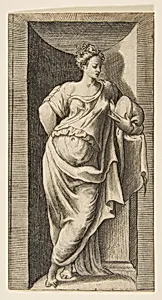
A muse standing in a niche, left arm resting in a ledge
ca. 1531–76
Medium
Engraving
Dimensions
sheet: 6 5/16 x 3 3/8 in. (16 x 8.5 cm)
Classification
Prints
Department
Drawings and Prints
Museum
Metropolitan Museum of Art, New York, NY
Credit
The Elisha Whittelsey Collection, The Elisha Whittelsey Fund, 1949
Accession Number
49.97.296
Rights
Public Domain
Tags
Art Historical Context
Giulio Bonasone, a leading Italian engraver of the 16th century from Bologna, created this delicate engraving titled *A Muse Standing in a Niche, Left Arm Resting on a Ledge* around 1531–76. Measuring just 6 5/16 x 3 3/8 inches, the intimate scale invites close viewing, revealing the precision of Bonasone's burin work on a metal plate. Active during the Mannerist era, he often reproduced designs by masters like Raphael and Parmigianino, bridging painting and printmaking to spread Renaissance ideals across Europe. The subject—a graceful muse poised in an architectural niche, her left arm casually draped over a ledge—embodies classical antiquity revived in the Renaissance. Muses, the nine Greek goddesses of the arts and sciences, symbolized divine inspiration for poets, musicians, and artists. Bonasone's engraving captures her elegant contrapposto pose and flowing drapery with fine lines and subtle tonal gradations, showcasing engraving's power to mimic painting's depth on paper. This technique democratized high art, making mythological elegance accessible beyond elite patrons. Housed in the Metropolitan Museum of Art's Drawings and Prints department as part of The Elisha Whittelsey Collection (1949), this print highlights the era's fascination with humanism and the female form, offering visitors a window into how 16th-century artists immortalized the spark of creativity.
About the Artist
Giulio Bonasone · 1500–1600
Comment on works: History; Mythology