
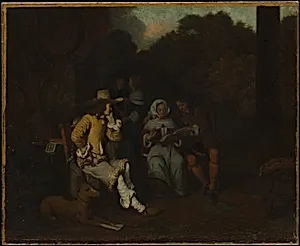
A Musical Party
early 1650s
Medium
Oil on canvas
Dimensions
20 x 24 1/2 in. (50.8 x 62.2 cm)
Classification
Paintings
Department
European Paintings
Museum
Metropolitan Museum of Art, New York, NY
Credit
Bequest of Annie C. Kane, 1926
Accession Number
26.260.8
Rights
Public Domain
Tags
About this artwork
This engaging genre scene demonstrates Gerbrand van den Eeckhout's sophisticated approach to depicting contemporary social life during the Dutch Golden Age. Painted in the early 1650s, the work shows a musical party with carefully observed details of costume, gesture, and psychological interaction. Van den Eeckhout, an Amsterdam artist active from 1621 to 1674 and a pupil of Rembrandt, developed a distinctive style combining his teacher's dramatic lighting effects with elegant genre painting con...
Art Historical Context
**A Musical Party** by Gerbrand van deneckhout captures the lively yet subtly introspective world of a Dutch Golden Age social gathering in the early 1650s. This oil-on-canvas genre scene, now at the Metropolitan Museum of Art depicts men and women enjoying music amid period costumes and a faithful dog, reflecting Amsterdam's prosperous urban life. As a pupil of Rembrandt ( 1621–1674), van den Eeck blended his master's dramatic lighting with refined genre conventions, elevating everyday merrymaking into sophisticated psychological portraits. The composition brims with observed details—gestures, spatial arrangements, and telling symbols like an empty chair hinting at unfulfilled desires or a young man's melancholic posture. This marks van den Eeckhout's early style, updating 17th-century "merry company" traditions with contemporary fashion and emotional depth, common among Amsterdam painters. Its attribution history adds intrigue: once credited to Barent Graat or Pieter de Hooch, it highlights the era's shared visual language and technical mastery that blurred artists' hands. Bequeathed to the Met in 1926 by Annie C. Kane, the painting exemplifies the Dutch Golden Age's genius for infusing mundane scenes with moral nuance and artistic brilliance, inviting viewers to ponder the joys and quiet sorrows of human connection. (198 words)
About the Artist
Gerbrand van den Eeckhout · 1621–1674
Comment on works: Religious; History; Portraits; Landscapes