
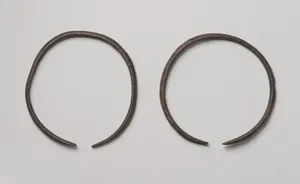
A pair of bracelets or anklets
Unknown Artist
270 B.C.–A.D. 320
Medium
Copper alloy
Dimensions
A: Dia. 5.6 × Th. 0.5 cm (2 3/16 × 3/16 in.) B: Dia. 5.6 × Th. 0.5 cm (2 3/16 × 3/16 in.)
Classification
Bracelet or anklet, pair
Period
Meroitic Period
Department
Egyptian Art
Museum
Metropolitan Museum of Art, New York, NY
Credit
Gift of Oxford University Expedition to Nubia, 1926
Accession Number
26.4.112a, b
Rights
Public Domain
Art Historical Context
This delicate pair of copper alloy bracelets anklets hails from the Meroitic Period (270 B.C.–A.D. 320), a vibrant era in the ancient Kingdom of Meroë in Nubia—modern-day Sudan. Unearthed during the Oxford University Expedition toia and gifted to the Metropolitan Museum Art in 1926, these small ornaments (each just 5.6 cm in diameter and 0.5 cm thick) likely adorned the wrists or ankles of children slender adults, offering a glimpse into everyday adornment in this powerful Nile Valley civilization. The Meroitic kingdom, successors to the Kushites, blended Egyptian influences with their own innovations, ruling as fierce rivals and traders with pharaonic Egypt and the Roman world. Copper alloys like these—possibly bronze—were prized for their durability and golden sheen, crafted through lost-wax casting or hammering techniques common in the region. Such jewelry symbolized status, protection, or beauty, often worn in life and buried with the dead. Though simple in form, these pieces highlight Meroë's metallurgical prowess, rivaling Egypt's, and their role in a society famed for pyramids, iron smelting, and a unique script. They invite us to imagine the jingle of ancient feet along the Nile, echoing a lost world's elegance.