
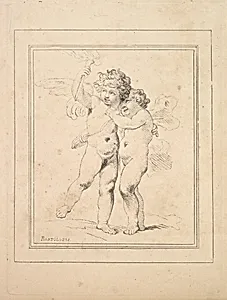
A Pair of Cupids – Cupid and Psyche
Medium
Soft-ground etching and stipple
Dimensions
Plate: 9 13/16 x 7 1/4 in. (25 x 18.4 cm) Sheet: 18 1/2 x 12 3/8 in. (47 x 31.5 cm)
Classification
Prints
Department
Drawings and Prints
Museum
Metropolitan Museum of Art, New York, NY
Credit
Harris Brisbane Dick Fund, 1933
Accession Number
33.7(6)
Rights
Public Domain
Tags
Art Historical Context
In the late 18th century, artist Thomas Rowlandson, renowned for his witty satirical drawings, collaborated with Italian engraver Francesco Bartolozzi to create *A Pair of Cupids Cupid and Psyche* (1784–88). This enchanting print draws from the ancient Roman myth of Cupid, the god of love, and Psyche, the woman whose trials symbolize the soul's journey toward divine love. Popularized in Apuleius's *The Golden Ass* and revived in Rococo art, the story captivated European audiences with its blend of romance, mischief, and metamorphosis—here rendered as a playful duo evoking tenderness and desire. Crafted in soft-ground etching and stipple—a dotted technique Bartolozzi perfected for its luminous, painterly effects—the work transforms Rowlandson's fluid lines into a delicate tonal masterpiece. Measuring about 10 by 7 inches on the plate, it exemplifies the era's reproductive printmaking, allowing affordable dissemination of classical themes to a wider public. Stipple's soft shading mimics the sfumato of oil paintings, bridging drawing and fine art. Housed in The Metropolitan Museum of Art's Drawings and Prints department (Harris Brisbane Dick Fund, 1933), this piece highlights the Georgian fascination with mythology amid Enlightenment elegance, inviting visitors to ponder love's eternal whimsy.
About the Artist
Thomas Rowlandson|Francesco Bartolozzi · 1756–1827
Thomas Rowlandson (1757–1827) was an English artist and caricaturist whose satirical watercolors and prints captured the social life of Georgian Britain with unparalleled wit and technical mastery. Alongside James Gillray, he is recognized as one of the greatest British graphic artists, and his distinctive flowing line and keen observations have made his work integral to understanding late 18th an...