
A parody of Narihira's eastern journey
c. 1764
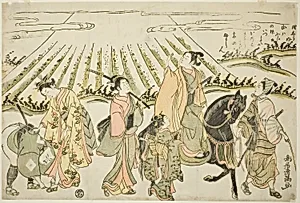
Medium
Color woodblock print; oban, benizuri-e
Dimensions
27.9 × 41.4 cm (11 × 16 5/16 in.)
Classification
woodblock print
Department
Arts of Asia
Museum
Art Institute of Chicago
Accession Number
44118
Rights
Public Domain
Art Historical Context
In the vibrant world of 18th-century Edo Japan, Torii Kiyomitsu I (1734–1785), a leading figure of the Torii school, created *A Parody of Narihira's Eastern Journey* around 1764. This color woodblock print reimagines a famous episode from the classical *Tales of Ise* (Ise Monogatari), where the Heian-era poet Ariwara no Nhira embarks on an adventurous journey eastward. Kiyomitsu transforms this literary tale into a playful *mitate-e*—a popular genre of parody—likely featuring kabuki actors or courtesans in contemporary attire, blending high culture with the bustling urban life of the floating world (*ukiyo*). Printed in the *benizuri-e* style on *oban* format (a generous 27.9 × 41.4 cm), the work employs an innovative early color technique: hand-applied rose-red pigment alongside green, blue, and black lines, bridging monochrome *sumizuri-e* and the later full-color *nishiki-e* ("brocade pictures"). This method allowed affordable mass production, making art accessible to merchants and commoners. Kiyomitsu's dynamic compositions and expressive figures captured the theatrical energy of kabuki, cementing his legacy in *yakusha-e* (actor prints). Housed in the Art Institute of Chicago's Arts of Asia collection, this print exemplifies ukiyo-e's cultural role in democratizing classical themes, offering witty commentary on tradition amid Japan's urban renaissance. Visitors will delight in its lively fusion of history, humor, and artistry.
About the Artist
Torii Kiyomitsu I · 1735–1785
Japanese, 1735–1785