
A Path Bordered by Trees with two Beggars and a Couple Strolling
late 18th century
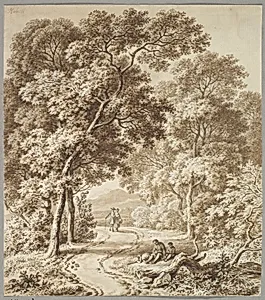
Medium
Pen and brown ink, brush and brown ink, on paper prepared with a light brown wash; framing line in graphite or black chalk
Dimensions
sheet: 7 5/8 x 8 3/8 in. (19.3 x 21.2 cm)
Classification
Drawings
Department
Drawings and Prints
Museum
Metropolitan Museum of Art, New York, NY
Credit
Harry G. Sperling Fund, 2011
Accession Number
2011.299
Rights
Public Domain
Tags
Art Historical Context
In the late 18th century, artist Ferdinand Kobell crafted *A Path Bordered by with Two Beggars and a Couple St*, a delicate landscape drawing that captures the serene beauty of rural life. Born into Munich's renowned Kobell family of painters, Ferdinand specialized in intimate, detailed scenes inspired by 17-century Dutch masters like Philips Wouwerman. work exemplifies his affinity for picturesque paths winding through wooded settings, where everyday figures—here, humble beggars and a leisurely couple—add a touch of human narrative to the natural world. Executed in pen and brown ink with brush and brown wash on lightly toned paper, the drawing showcases Kobell's masterful technique for evoking depth and atmosphere on a modest scale (7 5/8 x 8 3/8 in.). The brown wash unifies the composition, simulating sunlight filtering through trees, while a subtle graphite or black chalk framing line suggests it was a finished study, perhaps for etching—a medium Kobell favored. Such preparatory works were prized in Enlightenment-era Europe for their spontaneity and fidelity to nature. Housed in the Metropolitan Museum of Art's Drawings and Prints department, this piece reflects the era's growing Romantic fascination with landscapes as emblems of tranquility and social contrast, inviting viewers to ponder the quiet interplay of solitude and companionship along life's winding roads.
About the Artist
Ferdinand Kobell · 1740–1799
Comment on works: Landscapes with figures; Mountains; times of the day