
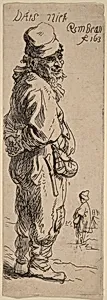
A Peasant Replying: "Dats niet" (That's nothing)
Medium
etching
Classification
Department
CG-E
Museum
National Gallery of Art, Washington, D.C.
Credit
Rosenwald Collection
Accession Number
1943.3.7268
Rights
Public Domain
Art Historical Context
In 1634, during the Dutch Golden Age, Rembrandt van Rijn created *A Peasant Replying "Dats niet" (That's nothing)*, a lively etching that captures a moment of rustic humor. This small-scale print depicts a peasant gesturing emphatically while uttering the Dutch dialect phrase "Dats niet," suggesting a folksy dismissal or boast—perhaps brushing off a challenge with down-to-earth bravado. Rembrandt, then in his late twenties and building his reputation in Amsterdam, frequently explored everyday genre scenes like this, blending portraiture with narrative flair. As a master printmaker, Rembrandt revolutionized etching techniques, employing fine lines, burr from drypoint, and subtle inking variations to achieve dramatic chiaroscuro effects akin to his paintings. The medium's accessibility allowed wide distribution, making his innovative realism available beyond elite patrons. This work exemplifies his early experimentation with expressive faces and textured clothing, hallmarks of his Baroque style infused with psychological depth. Housed in the National Gallery of Art's Rosenwald Collection (Department CG-E), this etching highlights Rembrandt's prolific output of over 300 prints, which were prized for their technical brilliance and human warmth. It invites visitors to appreciate how 17th-century Dutch art elevated ordinary folk to timeless subjects, reflecting a cultural shift toward celebrating the commonplace amid prosperity.
About the Artist
Rembrandt van Rijn · 1606–1669
Rembrandt Harmenszoon van Rijn (1606–1669) stands as one of the greatest visual artists in the history of Western art and the most important Dutch painter of the 17th century. Born in Leiden to a prosperous miller's family, Rembrandt transformed painting through his revolutionary use of light and shadow, his psychological depth in portraiture, and his elevation of etching to a fine art. His approx...