
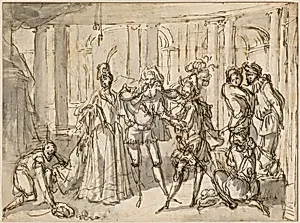
A Performance by the Commedia dell'Arte
c. 1710
Medium
pen and brown ink with gray wash on laid paper
Dimensions
overall: 15.9 x 21.4 cm (6 1/4 x 8 7/16 in.)
Classification
Drawing
Department
CG-E
Museum
National Gallery of Art, Washington, D.C.
Credit
Woodner Collection, Gift of Andrea Woodner
Accession Number
2006.11.13.a
Rights
Public Domain
Art Historical Context
Step into the vibrant world of early 18th-century French theater with Claude Gillot *A Performance by the Commedia dellte* (c. 1710). This lively drawing captures the exuberant chaos of Italy's famous improvised comedy tradition, featuring masked performers in dynamic poses mid-action. Gillot, a French artist and influential teacher to Antoine Watteau, delighted in depicting these theatrical scenes, blending humor and movement in works that bridged Baroque energy with emerging Rococo lightness. Commedia dell'Arte, with its stock characters like Harlequin and Pierrot, had captivated European audiences since the 16th century, influencing fashion, dance, and art across the Continent. By 1710, during France's Regency era following Louis XIV's death, such performances were all the rage at fairs and courts. Gillot's fascination with these troupes reflects a cultural shift toward playful, everyday spectacles over grand historical themes, foreshadowing the fêtes galantes that defined later French art. Executed in pen and brown ink with gray wash on laid paper (15.9 x 21.4 cm), the modest scale belies its technical finesse: fluid lines convey rapid gestures, while subtle washes add depth and drama. Housed in the National Gallery of Art's Woodner Collection, this drawing showcases Gillot's mastery of preparatory sketches, offering a window into the performative heart of Enlightenment-era leisure.
About the Artist
Claude Gillot · 1673–1722
Artist known for his elegant designs done in the Rococo manner of Audran; also for his predilection for scenes from the 'comedia dell'arte.' Few paintings survive; his work is known mainly through drawings and etchings. Comment on works: Genre; History