
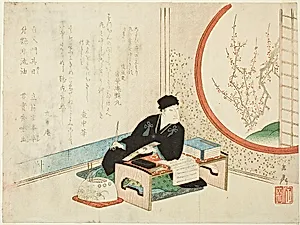
A Poet in the New Year
late 1820s
Medium
Color woodblock print; surimono
Dimensions
20.5 × 27.2 cm (8 1/8 × 10 3/4 in.)
Classification
woodblock print
Department
Arts of Asia
Museum
Art Institute of Chicago
Accession Number
80937
Rights
Public Domain
Art Historical Context
Welcome to the Art Institute of Chicago's of Asia collection, where Yashima Gakutei'sA Poet in the New* (late 1820s) captures the poetic spirit of Japan's Edo period. This intimate color woodblock print, just 20.5 × 27.2 cm, exemplifies *surimono*—luxurious, privately commissioned prints often exchanged as New Year's greetings among literati. Gakutei, a master of ukiyo-e ("pictures of the floating world"), specialized in these refined works, blending delicate imagery with calligraphy to evoke seasonal renewal and artistic camaraderie. The print's significance lies in its cultural role during the 1820s, a time when surimono flourished as bespoke art for poetry lovers, featuring embossed details, metallic pigments, and subtle colors achieved through precise woodblock carving and printing. Unlike mass-produced ukiyo-e, surimono like this one highlight Gakutei's skill in illustrating poets amid festive motifs—snowy scenes, plum blossoms, or festive robes—symbolizing hope and introspection at the year's dawn. This gem invites you to ponder Japan's harmonious fusion of word and image, a tradition bridging art and everyday celebration. Gaze closely to appreciate the tactile embossing and vibrant hues that still shimmer after two centuries!
About the Artist
Yashima Gakutei · 1786–1868
Yashima Gakutei (c. 1786–1868), born in Osaka as the illegitimate son of a Tokugawa shogunate samurai named Hirata, adopted the name from his mother's subsequent marriage into the Yashima clan. Little is documented about his early years beyond these familial ties, but he pursued artistic training under the esteemed ukiyo-e masters Totoya Hokkei and Katsushika Hokusai, absorbing their precision in ...